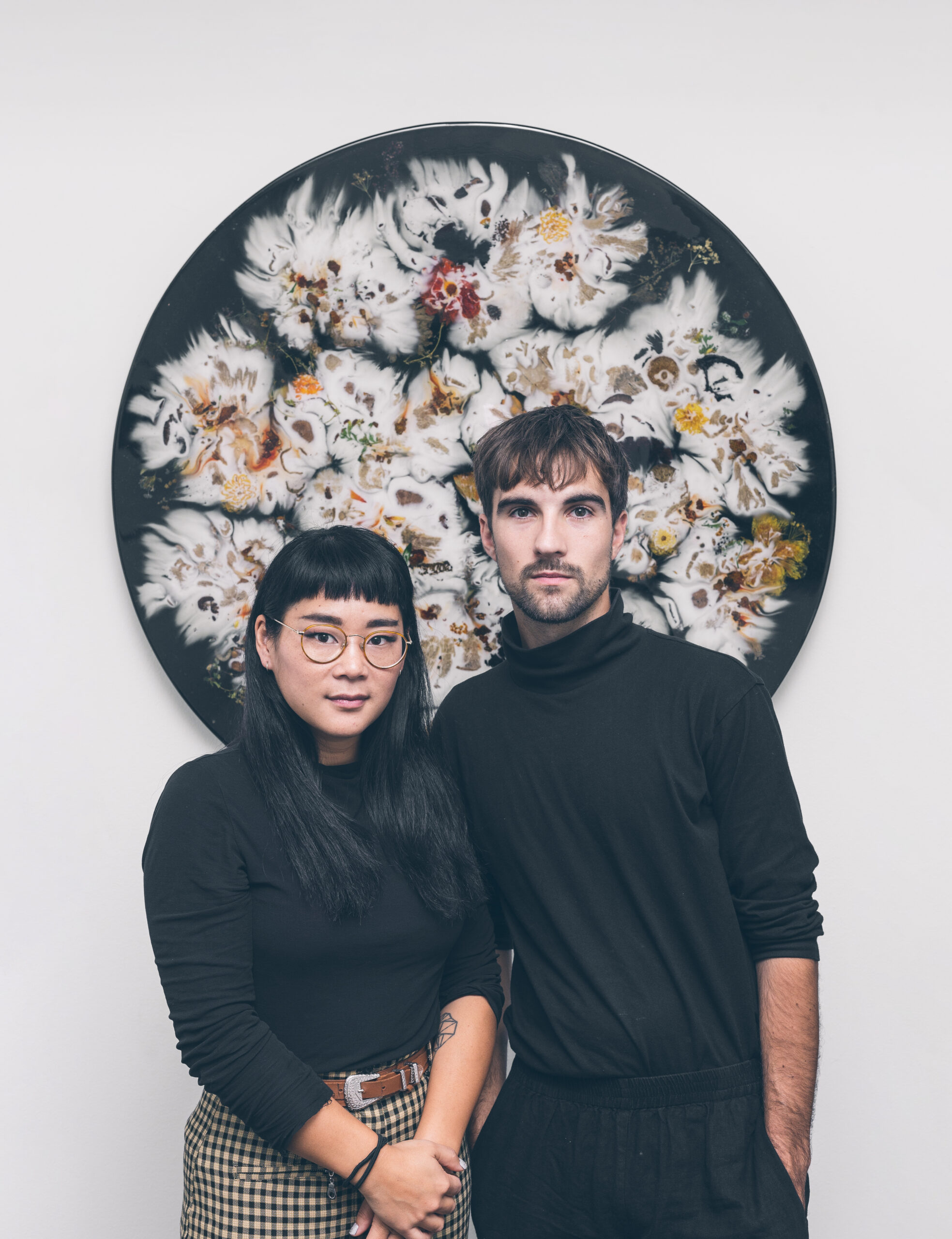
Artists Rhoda Ting and Mikkel Bojesen work at the intersection of art and science, creating works shaped by living organisms, geological processes and emerging technologies. Presented at Sydney Contemporary by Gallery Sally Dan-Cuthbert at booth B06, the Copenhagen-based duo speak with us about collaborating with scientists, looking beyond the human perspective, and how fungi, microbes and deep time are helping them imagine more interconnected and affirmative futures.
Your practice combines artistic inquiry with scientific research, often working with living organisms. How has collaborating with scientists changed the way you think about making art?
For us, art and science begin in the same place: with curiosity, imagination, and a desire to relate to the world. The difference is that science often seeks knowledge and certainty, while art can stay with paradox, ask questions, and create emotional connections that help us imagine different kinds of futures.
Working closely with scientists has expanded how we make art. Rather than illustrating scientific discoveries, we use scientific research as metaphors and starting points for new ways of imagining the world. We remember an evolutionary biologist telling us that some fungi have more than 28,000 genders, and that this incredible diversity is part of what makes them so adaptable. Learning about the rhizomatic networks of fungi, and how they exist through relationships rather than individuality, made us ask a simple but transformative question: Can we be more like fungi?
Our collaborations have also introduced us to environmental DNA sampling and advances in genetics, which reveal that we are all hybrids. Genetically, we have far more in common than we have differences. In many ways, science is showing us that nature is stranger, more diverse and more fluid than the categories we’ve inherited; it is queer, non-binary, and constantly changing. That inspires us to create work exploring co-evolution, interdependence, and the entangled relationships that make up life on a continuously transforming planet.
 Photo: Rhoda Ting & Mikkel Bojesen, Landscape Portrait (Detail) Courtesy the artists and Gallery Sally Dan-Cuthbert, Sydney.
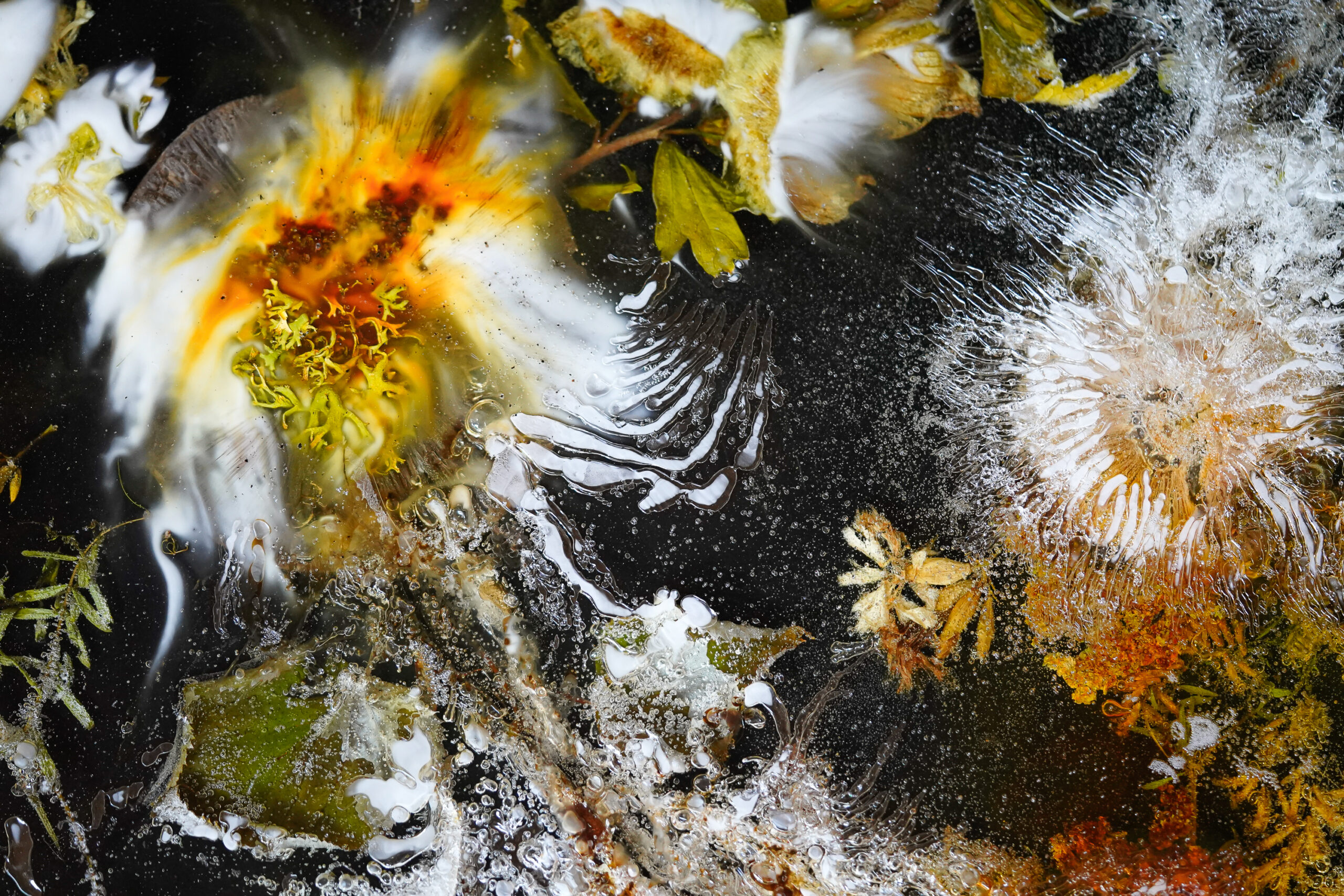 Photo: Rhoda Ting & Mikkel Bojesen, Landscape Portrait (Detail) Courtesy the artists and Gallery Sally Dan-Cuthbert, Sydney.
Many of your works invite us to think beyond a human perspective, whether through geological time, artificial intelligence or microbial life. Why is it important to challenge the idea that humans sit at the centre of the story?
It feels increasingly clear that the future many of us were promised, built around endless growth and human dominance, isn’t sustainable. When we first started working together, we realised something unsettling: we found it difficult to imagine a future beyond the end of the world, or even a world where humans weren’t at the centre of the story. That became one of the driving questions of our practice.
Mikkel’s background is in theology and art history, and from a European perspective there’s a long philosophical tradition, from Aristotle’s Scala Naturae through to humanism, that places humans at the top of a hierarchy. Discovering thinkers within queer ecology and posthumanism offered us a completely different way of seeing. Instead of placing humans above everything else, they invite us to see ourselves as one species among many, deeply entangled within a web of relationships. Yet what fascinates us is that, despite all the scientific evidence showing how interconnected life is, it remains incredibly difficult to truly decentre ourselves.
When we look at Earth’s history, we find a different perspective. Other species have survived five mass extinctions. Life has continually adapted, and complex biological life itself emerged from once toxic conditions. The planet has always been evolving through collaboration, mutation and transformation.
Our work tries to honour the intelligence and agency of other life forms, whether fungi, microbes, geological processes or even synthetic systems such as robotics and AI. By co-creating with these more-than-human collaborators, we’re constantly reminded that we are never fully in control and we are by no means the only intelligent species. That experience is deeply humbling.
Rather than imagining a return to a pure, untouched idea of nature, we’re interested in a future made up of many voices, many beginnings and many possible stories that includes synthetic life, industry and technology. A world experienced through relationships rather than hierarchies.
 Photo: Rhoda Ting & Mikkel Bojesen, Deep Time (Detail), glass, 12,000 year old ocean floor sediment from methane seepages in the Arctic Ocean, stainless steel, lights, Courtesy the artists and Gallery Sally Dan-Cuthbert, Sydney.
 Photo: Rhoda Ting & Mikkel Bojesen, Deep Time (Detail), glass, 12,000 year old ocean floor sediment from methane seepages in the Arctic Ocean, stainless steel, lights, Courtesy the artists and Gallery Sally Dan-Cuthbert, Sydney.
Works like the Interface Series are created over a period of time, while sculptures such as We Are All Hybrids imagine possible futures. How do you balance scientific reality with speculation and imagination in your practice?
By working with living systems, geological time and material processes, we stay grounded in scientific reality. But we also believe that imagination is essential. Scientific knowledge gives us a foundation, while speculation allows us to ask what kinds of futures might still be possible.
Our practice began with a desire to learn how to be in relationship with other species. Instead of simply representing nature, we wanted to create situations where nature could become an active collaborator and voice in the work.
In the Interface series, for example, we think of the repeated meetings between the ocean and industrial metal as the painter. The work develops through those encounters over time. In Deep Time, we worked with 12,000-year-old ocean-floor sediment collected from methane vents, folding it into molten glass so that ancient organic and mineral life could become visible again through the making process.
We’re particularly interested in what philosopher Rosi Braidotti calls affirmative futures. Rather than remaining in narratives of collapse, anxiety and dystopia, we want to create spaces where resilience, adaptation and co-evolution become visible. Nature continually shows us that worlds are still being built, and we hope our work offers a way of imagining ourselves as participants in those ongoing processes.
 Photo: Rhoda Ting & Mikkel Bojesen, We Are All Hybrids, Skagarrak 2, 2023 automotive paint, 3D-print, paster, resin, concrete, steel, 160 x 35 x 35 cm, Edition of 3, plus 2 AP, Courtesy the artists and Gallery Sally Dan-Cuthbert, Sydney.
 Photo: Rhoda Ting & Mikkel Bojesen, We Are All Hybrids, Skagarrak 2, 2023 automotive paint, 3D-print, paster, resin, concrete, steel, 160 x 35 x 35 cm, Edition of 3, plus 2 AP, Courtesy the artists and Gallery Sally Dan-Cuthbert, Sydney.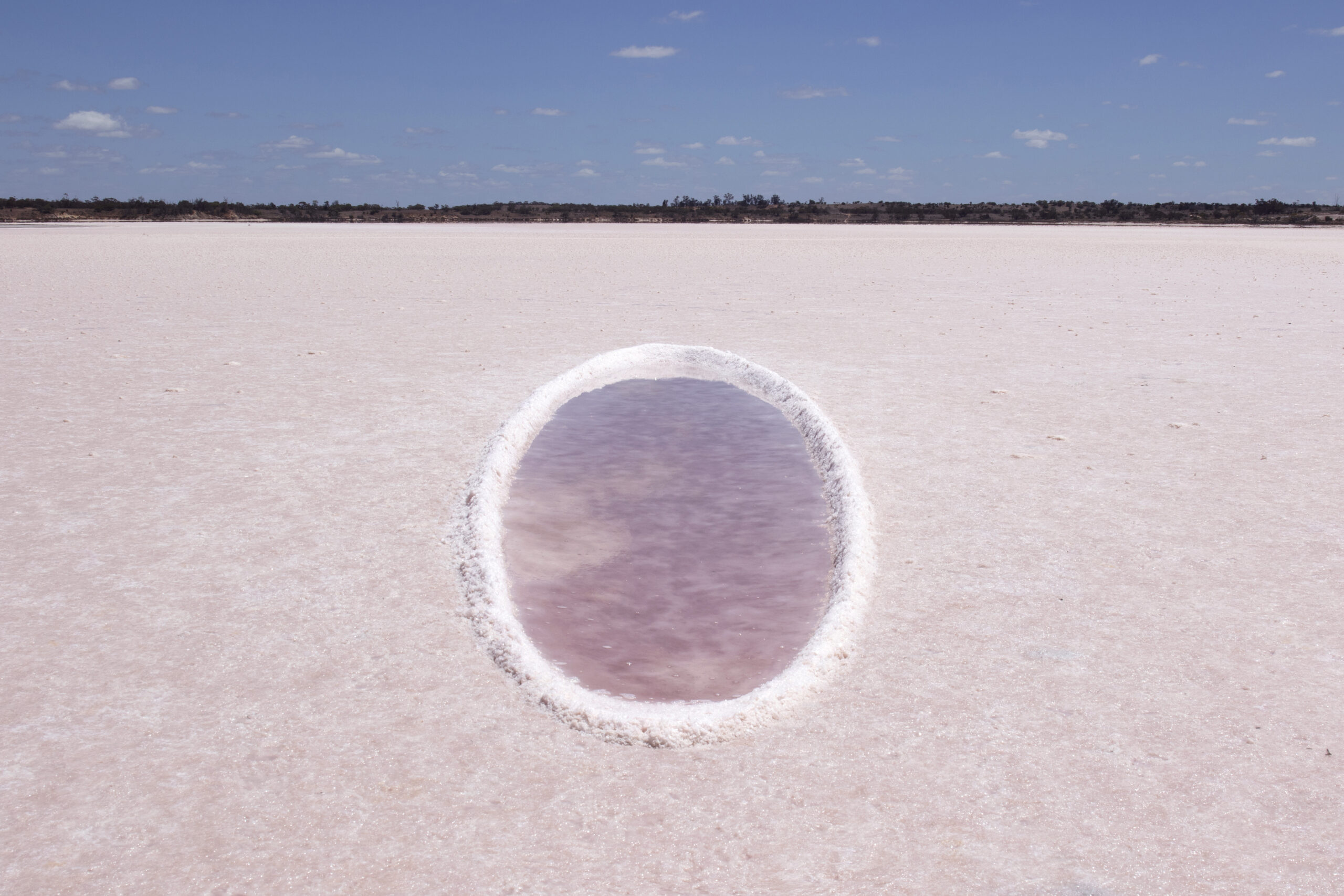
Photo: Rhoda Ting & Mikkel Bojesen, Quantum Field – Tunnelling, 2019, archival pigment print, oak frame, 100 × 150 x 5 cm, Edition of 3 plus 2 AP. Courtesy the artists and Gallery Sally Dan-Cuthbert, Sydney
For visitors discovering your work at Sydney Contemporary, what do you hope they leave thinking about, or perhaps seeing differently, after spending time with your installations and sculptures?
We hope people leave with a renewed sense that nature is resilient, wonderfully diverse and in constant evolution – and that we are not separate from it but deeply entangled within it. We hope visitors leave feeling a little more connected to the more-than-human world, and a little more curious about the intelligence and creativity that exists beyond ourselves.
We’re interested in the spaces where nature, industry, technology and humans meet, because that’s where new forms of life and new relationships are constantly emerging. Those intersections are often portrayed as sites of conflict, but we also see them as places of possibility.
Ultimately, we hope the work offers an affirmative perspective. Humans have undoubtedly contributed to many of today’s ecological crises, but we’re also part of the future. The question we’re always asking is: how can we learn to evolve together?
 Photo: Rhoda Ting & Mikkel Bojesen, Interface (Klintholm, winter, 7m/s, 18.12.2025), 2025, iron plate, oxidation, oak frame with museum glass, 130 x 90 x 6 cm (framed), Courtesy the artists and Gallery Sally Dan-Cuthbert, Sydney.
 Photo: Rhoda Ting & Mikkel Bojesen, Interface (Klintholm, winter, 7m/s, 18.12.2025), 2025, iron plate, oxidation, oak frame with museum glass, 130 x 90 x 6 cm (framed), Courtesy the artists and Gallery Sally Dan-Cuthbert, Sydney.
After Sydney Contemporary, what’s happening next in the world of Rhoda Ting and Mikkel Bojesen?
We’re excited about a busy year ahead. In early 2027, we’ll be part of the group exhibition (Un)Human Being at Kunsthalle Düsseldorf, opening in February. In March, we’ll open a solo exhibition at Ordrupgaard in Denmark, and we’re also installing a permanent rhizomatic wind sculpture at Aalborg University in Esbjerg, Denmark.
Alongside these projects, we’ll be working towards our first solo exhibition with Gallery Sally Dan-Cuthbert in early 2028. It’s an exciting moment for us, as all of these projects continue our ongoing conversations around co-evolution, hybridity and imagining more affirmative futures.
 Photo: Rhoda Ting & Mikkel Bojesen, Landscape Portrait #63, 2023, epoxy, pigment, flora and fungi (Sjælland, Denmark), Ø 110 x 3 cm, Courtesy the artists and Gallery Sally Dan-Cuthbert, Sydney.
 Photo: Rhoda Ting & Mikkel Bojesen, Landscape Portrait #63, 2023, epoxy, pigment, flora and fungi (Sjælland, Denmark), Ø 110 x 3 cm, Courtesy the artists and Gallery Sally Dan-Cuthbert, Sydney.