Zac Langdon-Pole’s practice brings together art, science and history, drawing on disparate images, objects and cultural references to explore the connections that shape our understanding of the world. Through processes of recontextualisation and transformation, Langdon-Pole challenges familiar ways of seeing, examining how meaning shifts across cultures and generations, and how the boundaries between things are continually redefined.
We spoke with Langdon-Pole on the role of curiosity and perspective in his practice, the relationship between objects and their representations, and the possibilities of transformation as a way of rethinking how we see, understand and belong in the world.

Zac Langdon-Pole, Forest Branches, 2026. Courtesy the artist and STATION.
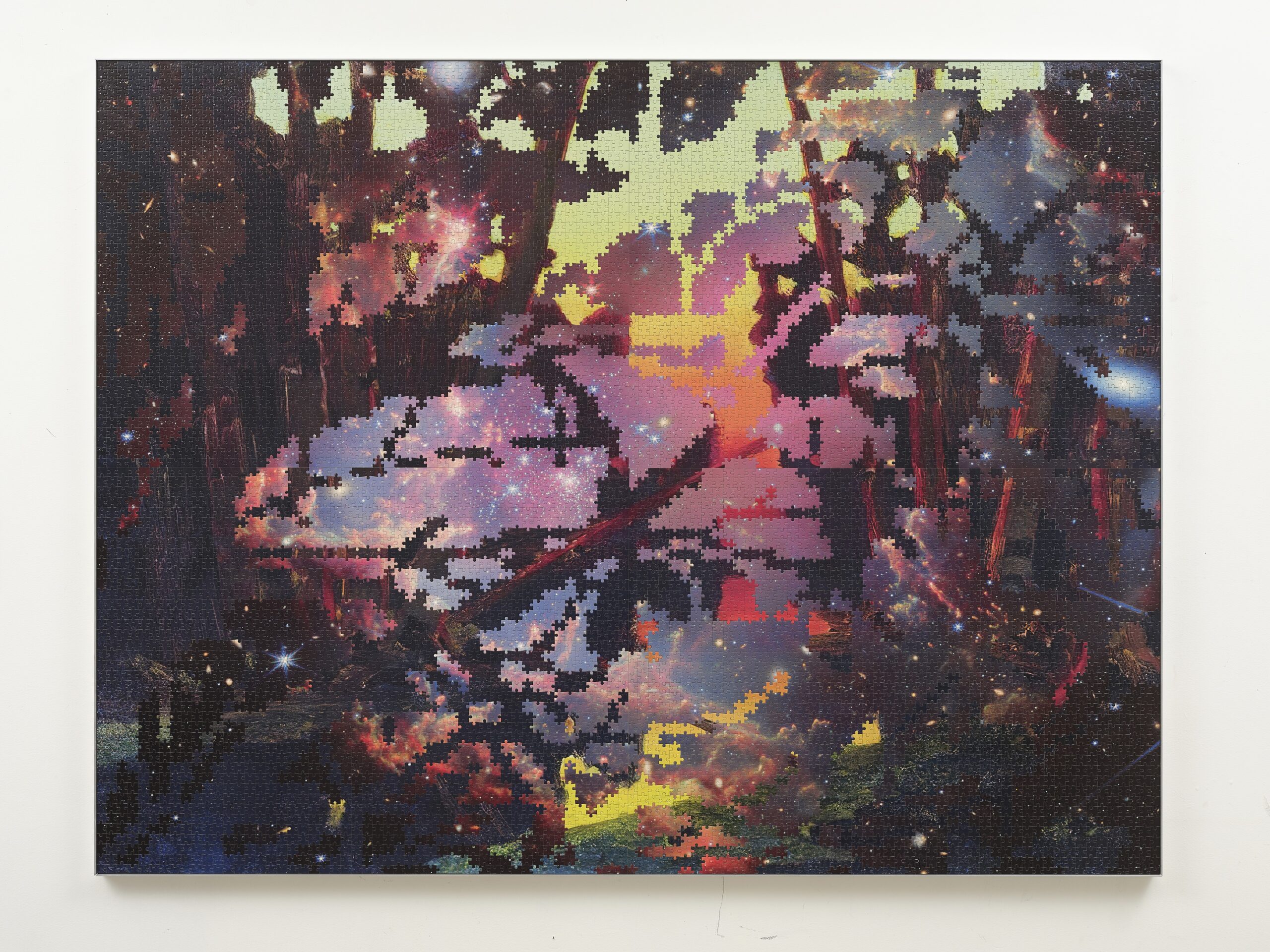
Your practice brings together images, objects and histories from different contexts. What draws you to these connections, and how do they shape the work?
I’m drawn to the unexpected connections that lurk beneath the surface of everyday life and alter our preconceptions about how the world works. Right now, it feels as though we are becoming increasingly siloed into ever-smaller realms of experience. For me, art is a vocation of curiosity and expansion. It follows, then, that my work casts a wide net of connection points, drawing on disparate histories, objects and images to broaden our understanding of the forces that have deposited us into the present.
You often explore how meaning changes over time. What interests you about the way objects and images are interpreted differently across cultures and generations?
It’s a given human bias that we treat our own lives and times as exceptional. It’s easy to forget that the same issues have been plaguing humanity for eons regardless of geography and timescale. To this end, I’ve always loved the ancient parable of the blind men and elephant. The story goes that five blind men who have never encountered an elephant before are each positioned around different parts of the animal and asked to explain what’s there. The man holding the trunk describes a snake, the man holding the ear describes a fan, the man touching the leg describes a tree trunk, etc, etc… Each claims an absolute, yet wildly different, truth based on their partial, subjective experience.
While the traditional moral illustrates the limitations of human perspective, I am more interested in what happens when these multiple viewpoints are deftly brought together. You end up with this fantastical composite where each perspective holds its own truth but also contributes to a version of reality that can be as astonishing as it is engrossing.
 Zac Langdon-Pole, Moth Plant (Invasive), detail, 2026. Courtesy the artist and STATION.
 Zac Langdon-Pole, Moth Plant (Invasive), detail, 2026. Courtesy the artist and STATION.
Your work moves between art, science and history, how do these inform one another in your practice?
Each of these fields hold the best set of tools we have for engaging with the world, so why limit yourself to only one toolbox? I am not a scientist or a historian though, I work solely within an art context. So there are certain liberties I’m able to take, there are means without an end.
There is often a tension between what we recognise and what remains unfamiliar in your work. What reflections do you hope your work invites from audiences?
I’m looking for an experience where the familiar becomes strange and the strange becomes familiar. I’m interested in a type of work that can be as informative as it is inexplicable. I like the idea that an artwork might teach us something—that if you follow the evidence of what is there, you will be rewarded for as far as you can take it. But at the same time, an engagement with the work should never lose touch with the ineffable.
Zac Langdon-Pole, Is a Rose, detail, 2026. Courtesy the artist and STATION.
 Zac Langdon-Pole, Is a Rose, detail, 2026. Courtesy the artist and STATION.
You frequently re-contextualise existing materials; what interests you about transformation as a way of making work?
Transformation is at the heart of what I do. It’s there as a reminder that everything is changing all of the time. It’s rooted in the idea that difference coming together is what creates the world. Transformation, then, becomes a way of demonstrating that another way of looking, thinking, and being is always possible.
 Zac Langdon-Pole, Monarch Wing Detail (Shattered Screens), 2026
 Zac Langdon-Pole, Monarch Wing Detail (Shattered Screens), 2026
Can you tell us about the ideas informing your upcoming exhibition with STATION? What questions have been guiding this body of work?
The exhibition’s title, Is a Rose?, borrows from Gertrude Stein’s famous line “A rose is a rose is a rose,” only it’s been clipped and reposed as a question. Where Stein’s line originally emphasised a stripped-back matter-of-factness of language, I’m interested in foregrounding the uncertain and back-and-forth relationship between the actual and its representation. This all stems from my ongoing interest in questions of belonging; i.e what belongs where, how do we classify and order the world? What systems shape the way we see? And, when does one thing become another?
Zac Langdon-Pole’s exhibition is on from 14 November to 23 December 2026 at STATION, Melbourne