William Mackinnon’s paintings transform the familiar into something unexpected, drawing on the everyday landscapes of roads, houses, street signs and coastal surrounds. Moving between Australia and Europe, Mackinnon explores the instability of place and perception, where ordinary imagery becomes a vehicle for something more psychological, and the act of painting opens up new ways of seeing.
We spoke with Mackinnon on the role of memory and intuition in his practice, his resistance to idea-driven art, and the possibilities of painting as a medium for expressing the complexity of human experience.
Exhibition Name
12 November – 12 December
Hugo Michell Gallery
Images courtesy the artist and Hugo Michell Gallery. Photography: Sam Roberts.

William Mackinnon, Snakes and Ladders / The Game of Life, 2025, acrylic, oil and automotive enamel on linen, 160 × 130 cm
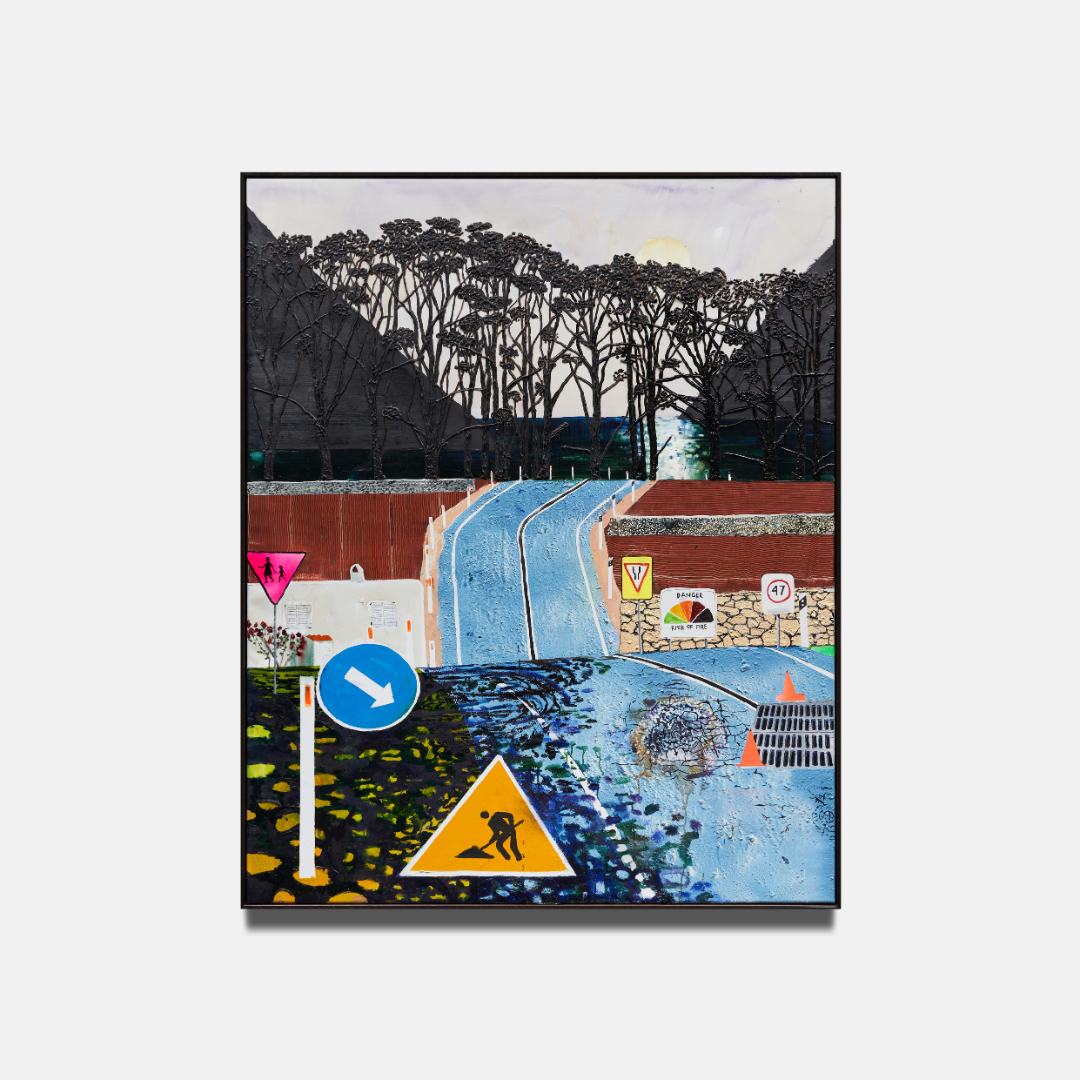
Your landscapes hold a tension between wonder and unease. How important is that duality to the way you approach painting?
I don’t paint with thoughts, words or themes in mind. I try to be true to my experience of living in the world. I am very sensitive, so this observation is valid, but I think what is so compelling about painting is that it is beyond the dualities of language. There is a lot of art that comes out of “research and illustrates a thesis” but it leaves me cold. Wonder is important, as much in terms of surprising oneself in the act of painting. The best paintings have an emergent quality, where something interesting happens in the making
You’ve described a close relationship with the coastal landscape. How has living within it shaped your understanding of place?
I am a very visual person, and I use the world around me as the subject matter. Not necessarily literally; often I am more focused on the banal, or everyday imagery of street signs, cracks in roads, houses and more recently tennis courts. These elements are stand-ins for emotional states or something in the human experience like ageing, or having kids or getting divorced. The road which I have painted is like a stage, to introduce characters or events. I live half my time in Ibiza and half the time down the surf coast, but I am more focused on headlights, wheelie bins, swimming pools and roads.
William Mackinnon, Night games (3), 2025-26, Acrylic, oil and automotive enamel on linen, 130 x 160 cm. Photo: Sam Roberts Photography.
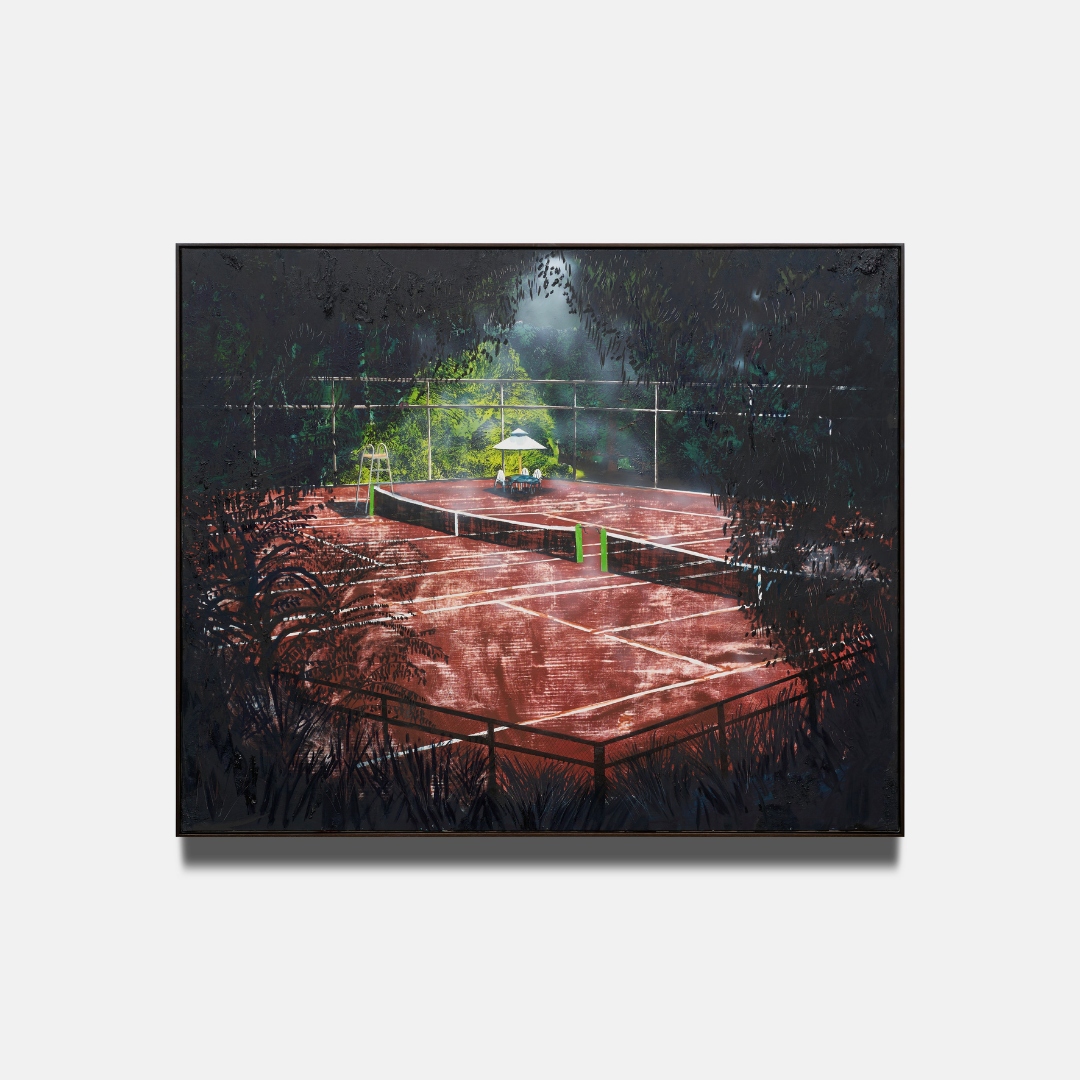
Your paintings suggest that the familiar can become extraordinary, even unsettling. How do you find that tension within the everyday landscape?
Lucian Freud wrote that all painting is about memory and attention. Even if you are painting a model, you still have a gap between looking and then making a decision of what to do and then there is a further slippage of what actually comes out regardless of intention.
All painting is a metaphor; there is a huge amount of contrivance, conceit, organisation. Again, look how riveting each of Freud’s works are, what he did in terms of painting with a very straightforward genre, and how much that changed over his lifetime. All against the tide of what was popular.
It is not what you paint, but how you paint, which is really compelling. When one sails close to the wind with a subject, you are forced to be very inventive with how you paint to make it interesting. A bit like John Clarke with something like “The Games”. As my subjects are very easily apprehended, you can see how much I am doing with the medium.
William Mackinnon, Golden Brown, 2026, Acrylic, oil and automotive enamel on linen, 260 × 200 cm
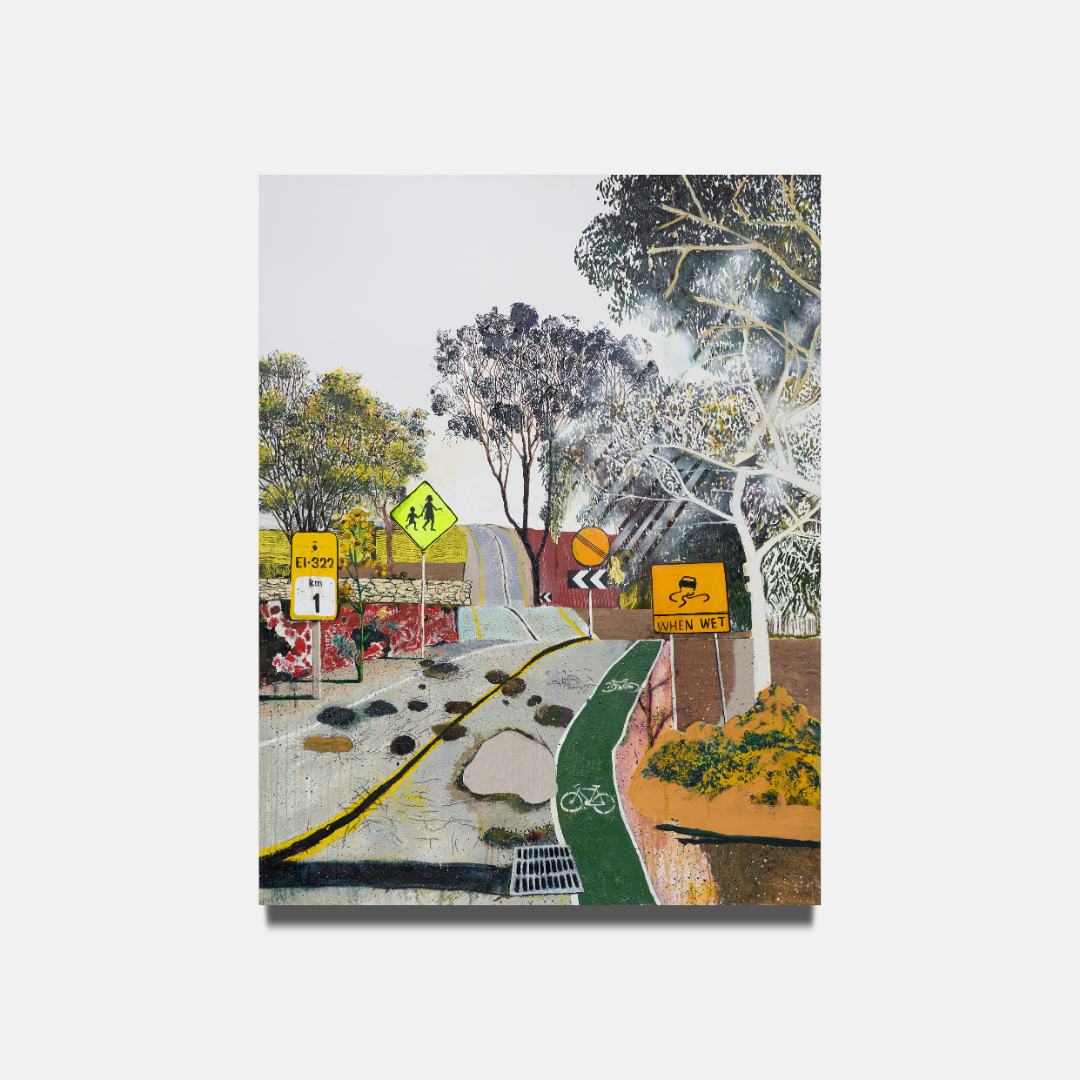
Looking back across your practice, what questions about painting and perception continue to hold your attention?
I seem to answer the question in the previous answer to all these questions! I find perception and consciousness really fascinating. The older I get and more I see how perception, meaning and consciousness are intertwined and constantly shifting. “Seeing” is a very active process, as is making sense of the world.
The more I look and paint, I seem to find infinite possibilities all around me. The world keeps changing and so do I. So, one could keep painting the same subject, which I often do and always find it pregnant with possibilities. Like Cézanne and Mont Sainte-Victoire.
There’s often a sense of movement and displacement in your compositions. What interests you about the instability of a landscape, and how do you translate that into paint?
I guess I am trying to remind people that this is a construction, an invention is a painting they are looking at. I am not painting a single place.
Every two months I move between Europe and Australia, so that affects the work. Also, they reflect the human experience, which is not coherent. Things are popping into our minds all the time, or we are colliding with people; we are ageing, having kids and our identity is shifting as is our understanding of the world. I want my work to reflect the complexity of the human experience. It is very complex what is going on day to day and hard to convey in words all the layers of what is going on in the mind. Painting for me is a way of thinking and seeing. It is poetic, playful and mysterious.
William Mackinnon, Memory of going out at the point, 2025-26, Acrylic, oil and automotive enamel on linen, 160 x 130 cm. Photo: Sam Roberts Photography.
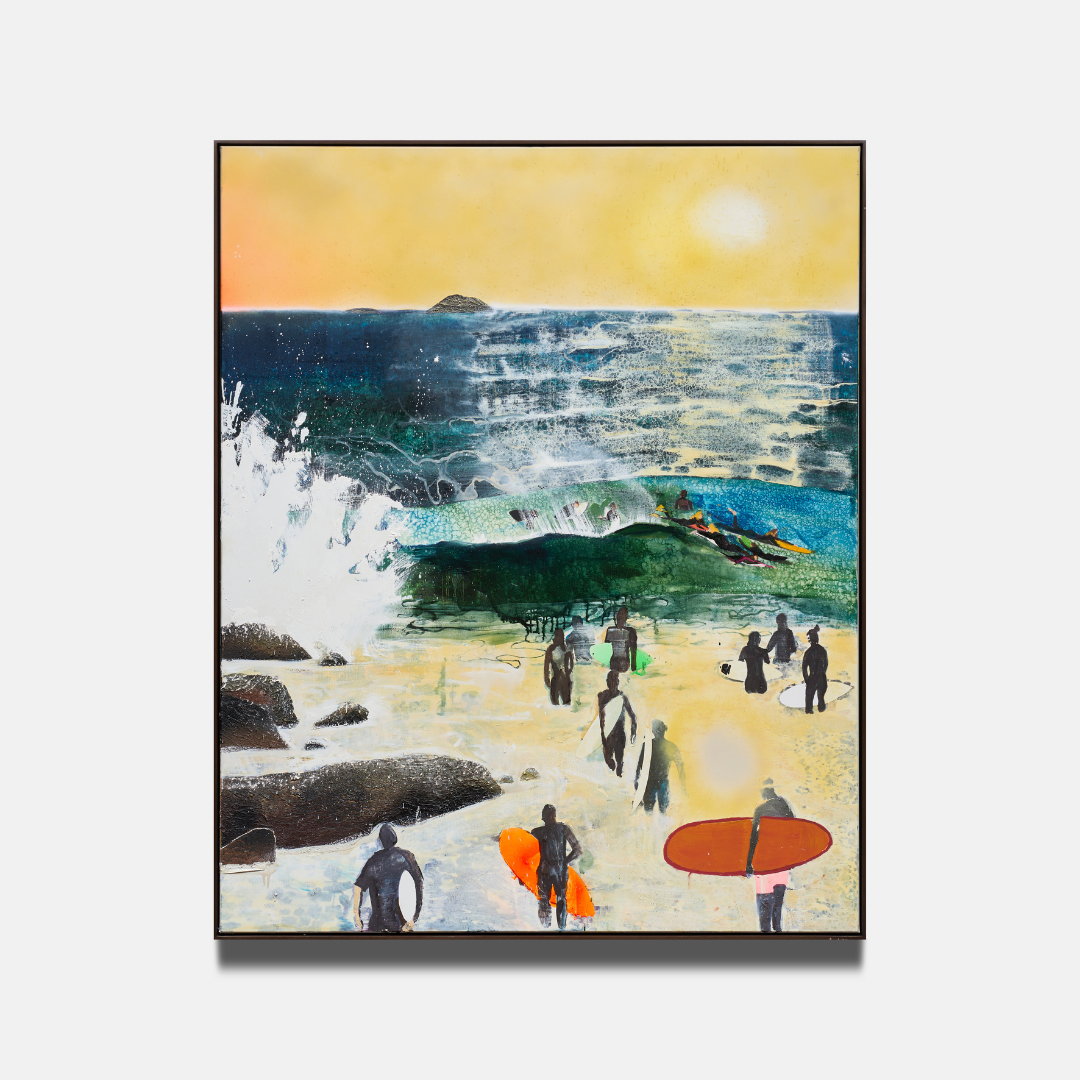
How does memory inform your work, and at what point does a real place become something more psychological?
I am not sure how to answer this. One thing is it takes me some time before I will use elements from my life in a painting. It took about 6 years of living in Spain before I thought I could use the trees, road signs and houses. It is about familiarity and emotional connection. I need that charge to connect with a subject.
Can you tell us about the ideas underpinning your upcoming exhibition at Hugo Michell Gallery?
For me painting is about discovery. It is a mysterious and strange process of attraction and long periods of tinkering and not really knowing what you are doing exactly.
To be honest I really dislike “ideas art “ where the idea comes first….normally the ideas are pretty thin and I don’t think any great art has come out of this approach. Really powerful paintings or music don’t need to be explained as they hit you directly.
This is a serious point, that ideas are literary things, word-based concepts. This is not where great art or music comes from in the brain. Creativity bypasses this clunky, dry medium….. words are like the tip of the iceberg, and it is sad they dominate the art world. Art school is now all about “research”. Great art comes from mastery and fluency of a medium, not trying to illustrate ideas but is something you wrestle with and express powerfully and directly through your medium without having to prop it up with some art jargon. It comes from a different type of intelligence.
William Mackinnon, Night Paddle, 2026, acrylic, oil and automotive enamel on linen, 160 × 130 cm
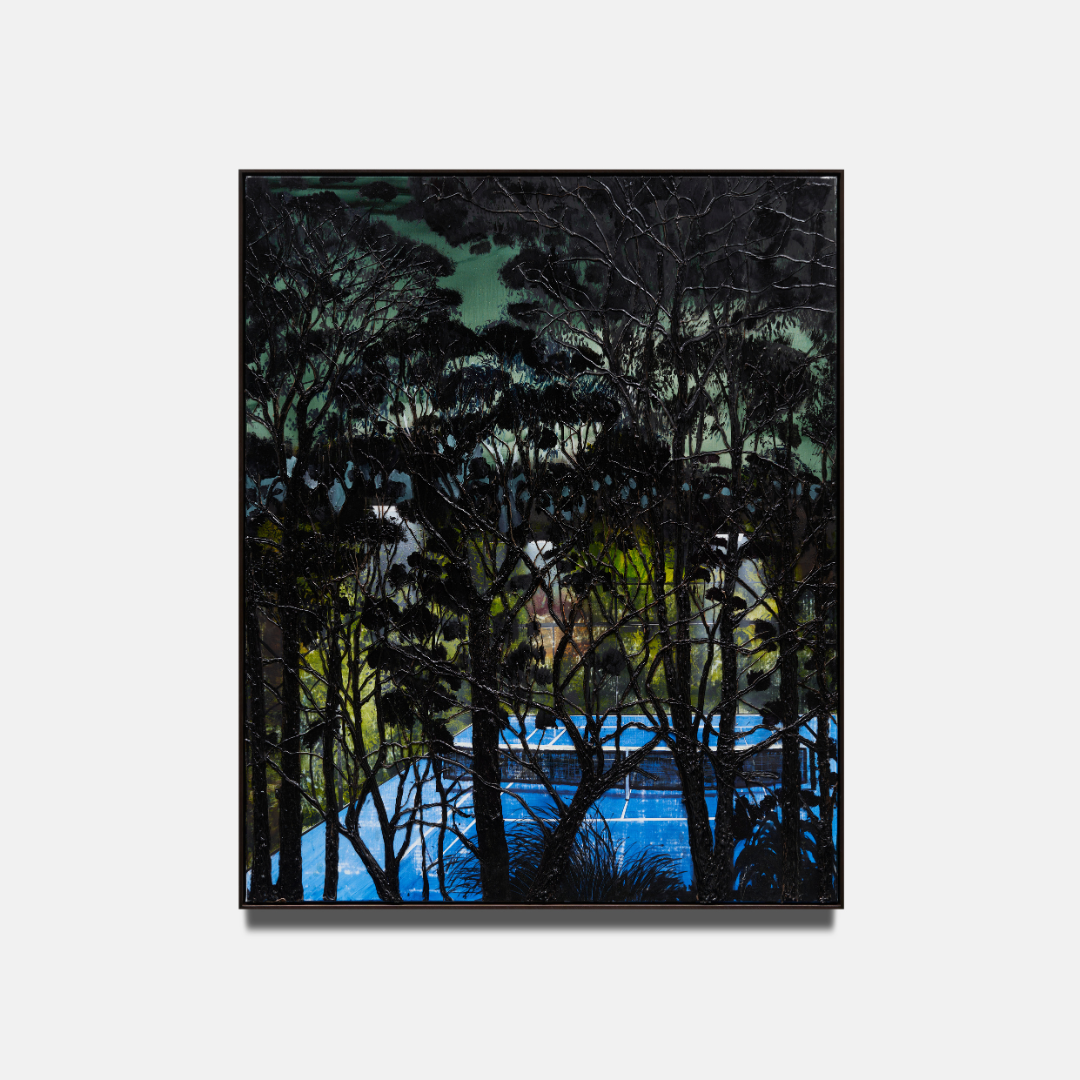
Your work often invites us to slow down and pay attention to things that might otherwise pass unnoticed. What conversations or reflections do you hope your work invites from audiences?
I want to engage people in an open-ended way. That they can live with a painting for decades and continue to see things, associations, rhymes, play and pleasure.
I love paintings; I collect art myself. Good paintings give you pleasure every day. That is my goal to make something that makes your heart skip and mind race like when I see something really great. To create excitement, something inventive, fresh yet resolved. Something that is unlike any predecessor. I am trying to do something great, but always falling short; it is that possibility of making something really arresting that is so alluring.
William Mackinnon, The Inner Game, 2026, acrylic, oil and automotive enamel on linen (diptych), 200 × 300 cm
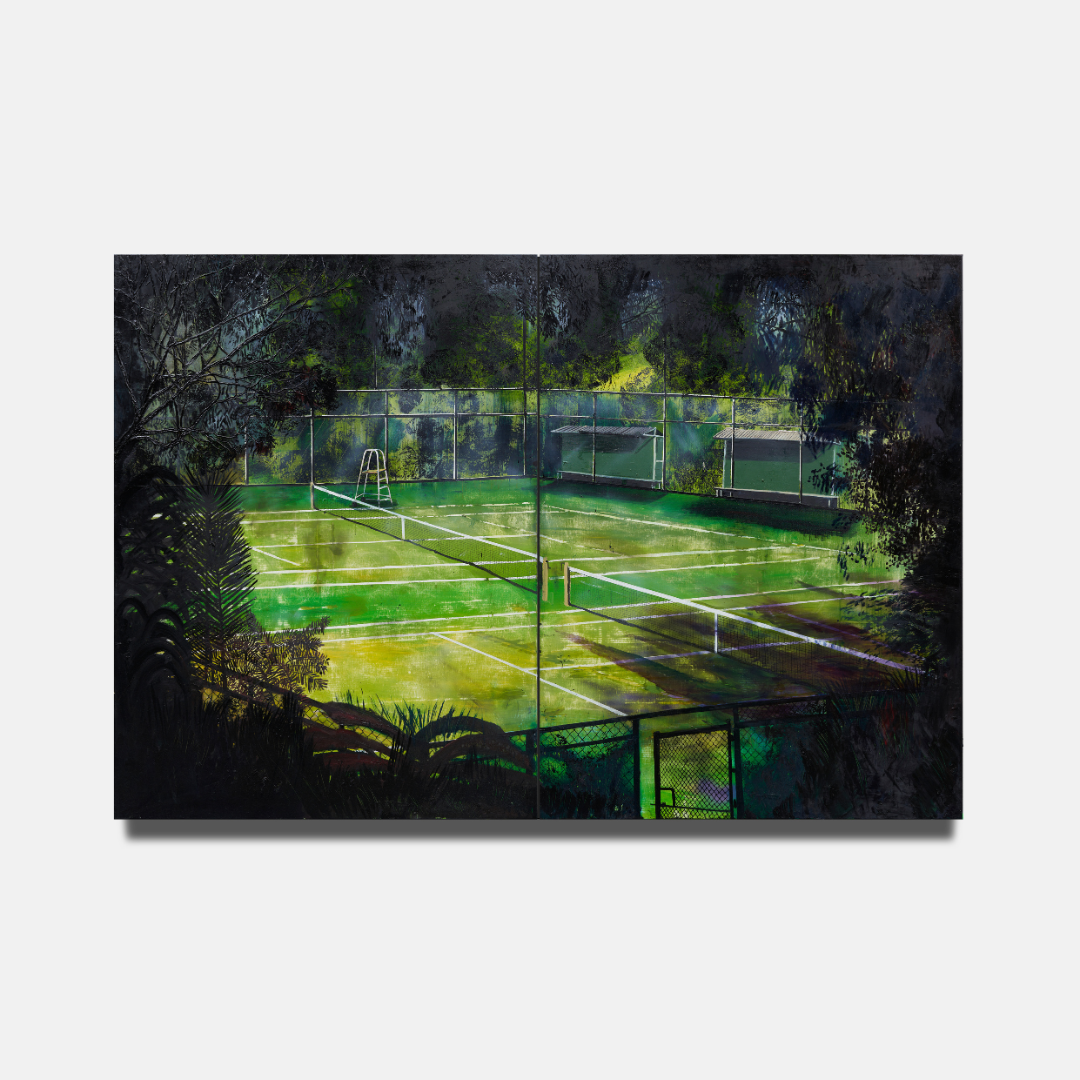
Looking ahead, are there particular projects, collaborations, or mediums you’re excited to explore?
I am making 3 lithographs with Adrian Kellet, which is really interesting. I am working on a big project called the “artists’ beach house “ it feels like my Giverny or the coda to my life. It is bringing together landscaping a garden that runs down to the ocean, architecture and my collection of paintings in a kind of museum of the analogue and aesthetics. It’s something I have dreamed of doing and in fact made many paintings about @the_artists_beachhouse.
William Mackinnon’s exhibition is on from 12 November to 12 December 2026 at Hugo Michell Gallery.