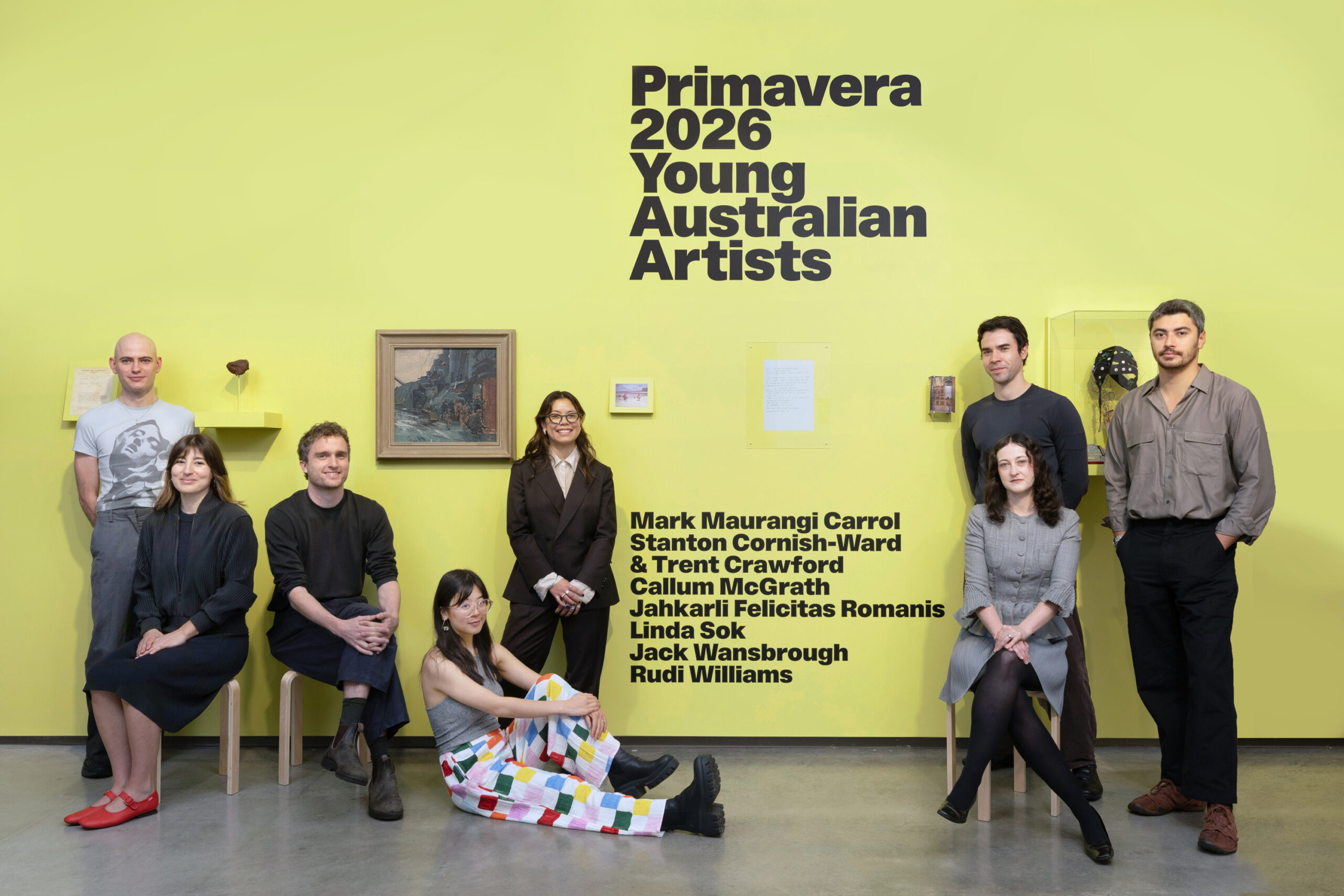
For Primavera 2026, curator Antares Wells brings together eight young Australian artists drawn to the traces the past leaves behind: in bodies, objects, landscapes, archives and memory. The exhibition moves between the intimate and the historical, the personal and the collective, asking what survives, what disappears, and who gets to decide what is remembered.
Across painting, film, photography, weaving and installation, these artists approach history from oblique and often unexpected angles. The result is an exhibition that feels at once deeply considered and gloriously unruly: a place where found objects, lost stories and fragments of memory collide, and where the past keeps pressing into the present.

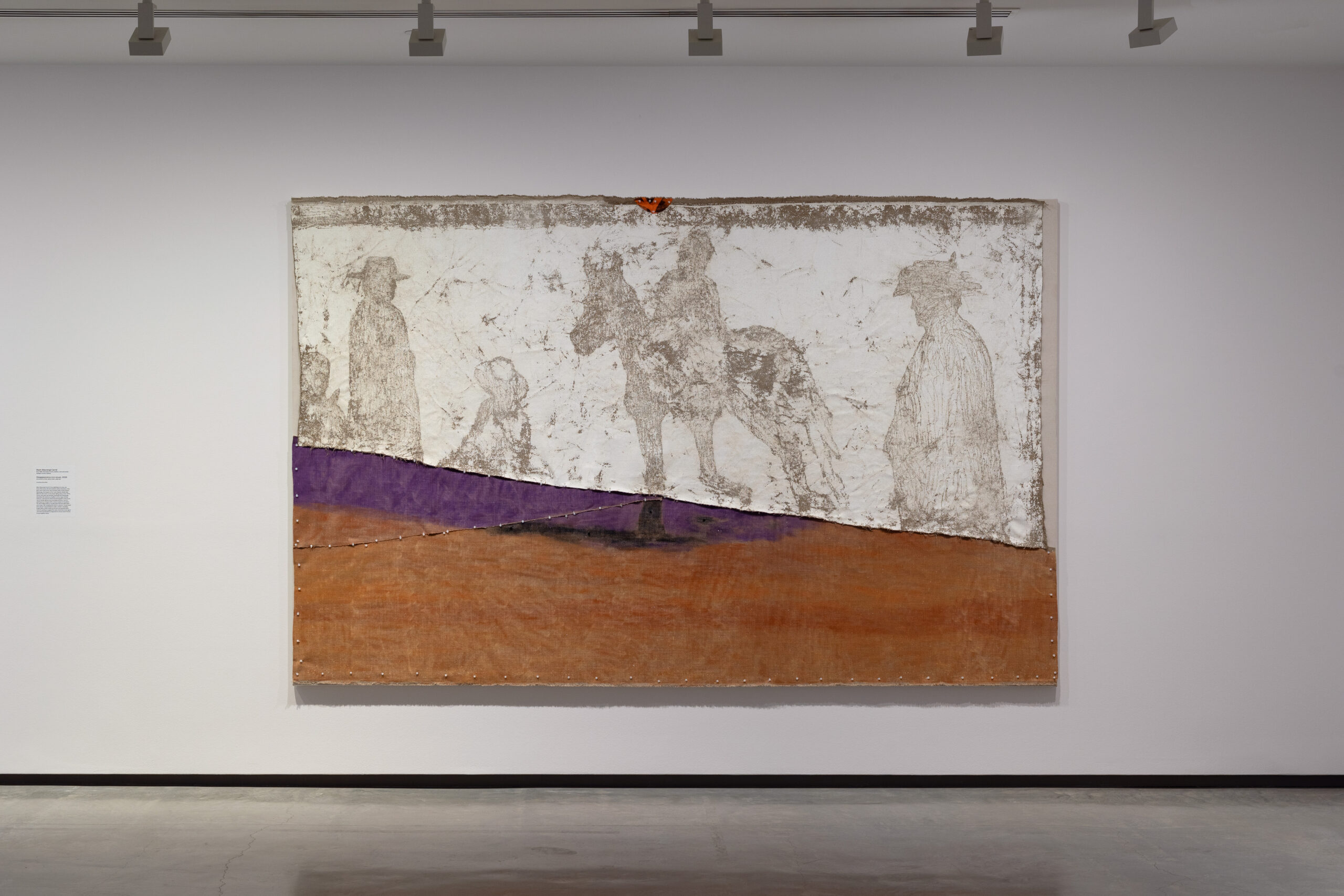
Mark Maurangi Carrol, Disappearance (oro enua), 2026, oil enamel on linen, pāreu cloth, cable ties, installation view, Primavera 2026: Young Australian Artists, Museum of Contemporary Art Australia, Sydney, photograph: Jessica Maurer
How would you best describe this year’s Primavera?
Primavera 2026: Young Australian Artists features the work of eight artists: Mark Maurangi Carrol, Stanton Cornish-Ward & Trent Crawford, Callum McGrath, Jahkarli Felicitas Romanis, Linda Sok, Jack Wansbrough and Rudi Williams. Their work is both emotional and analytical – it has a kind of felt precision. It’s shot through with intellect, but it’s not cold. The exhibition is idiosyncratic, at times eccentric and obsessive. There’s a preoccupation with material culture and the found object throughout the exhibition that gives it a certain unruliness, and it’s materially quite diverse. Someone at the opening described it as ‘unhinged’. I liked that.

Rudi Williams, In the air we breathe, 2026, installation view, Primavera 2026: Young Australian Artists, Museum of Contemporary Art Australia, Sydney, photograph: Jessica Maurer
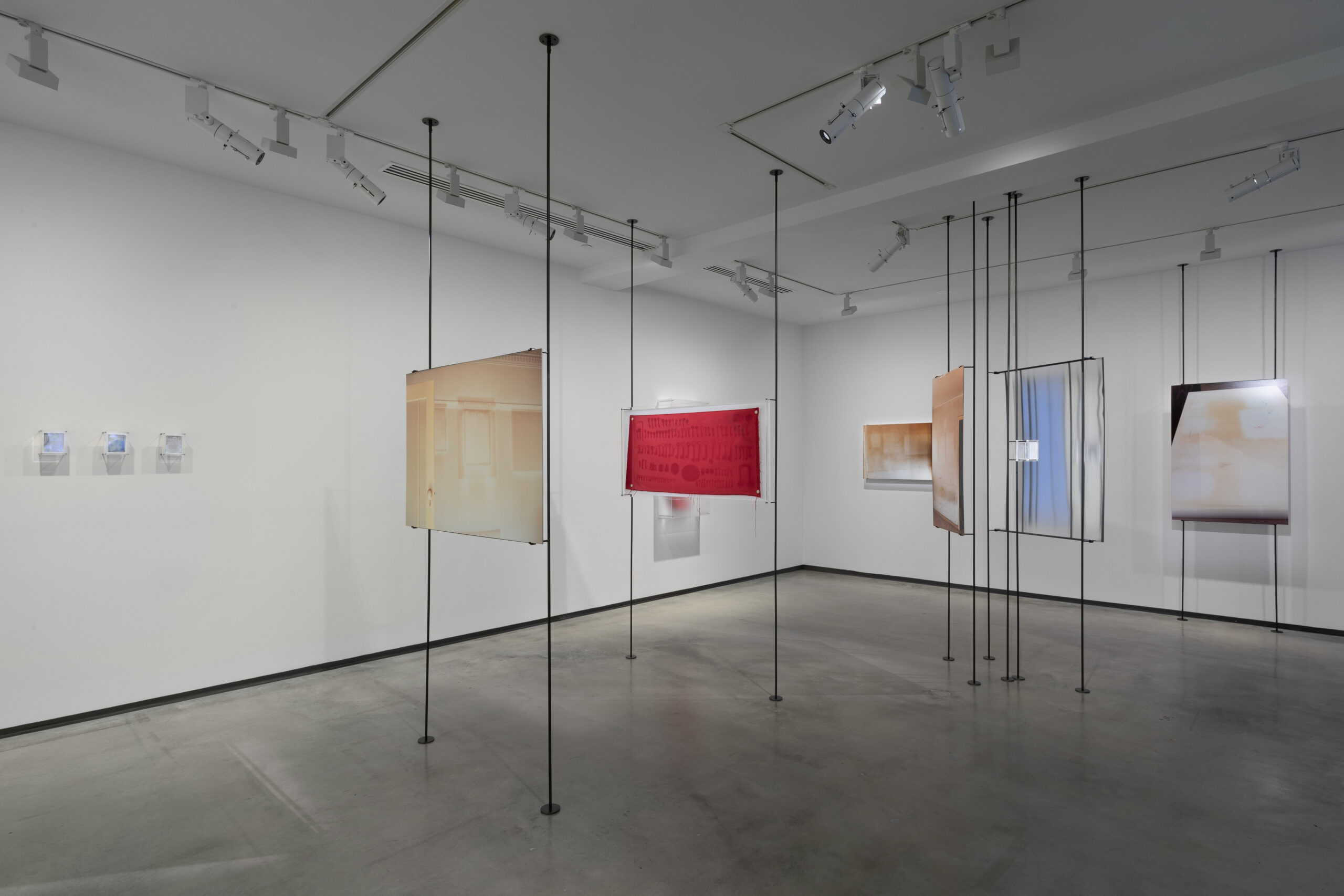
What was the initial instinct or suspicion that led you towards this group of artists?
These artists are preoccupied in different ways with what I’ve called ‘the material and psychic traces of the past’. They consider these traces on different timescales, from the geological to the span of a single human life. They are orbiting similar ideas but coming at them in different ways. There are points of convergence, but I don’t think the artists all agree with each other. If they did, that to me would be a far less interesting exhibition. I’m interested in how all these different approaches spin out from similar preoccupations.

Linda Sok, Deities in Temples XXI, 2026, installation view, Primavera 2026: Young Australian Artists, Museum of Contemporary Art Australia, Sydney, photograph: Jessica Maurer
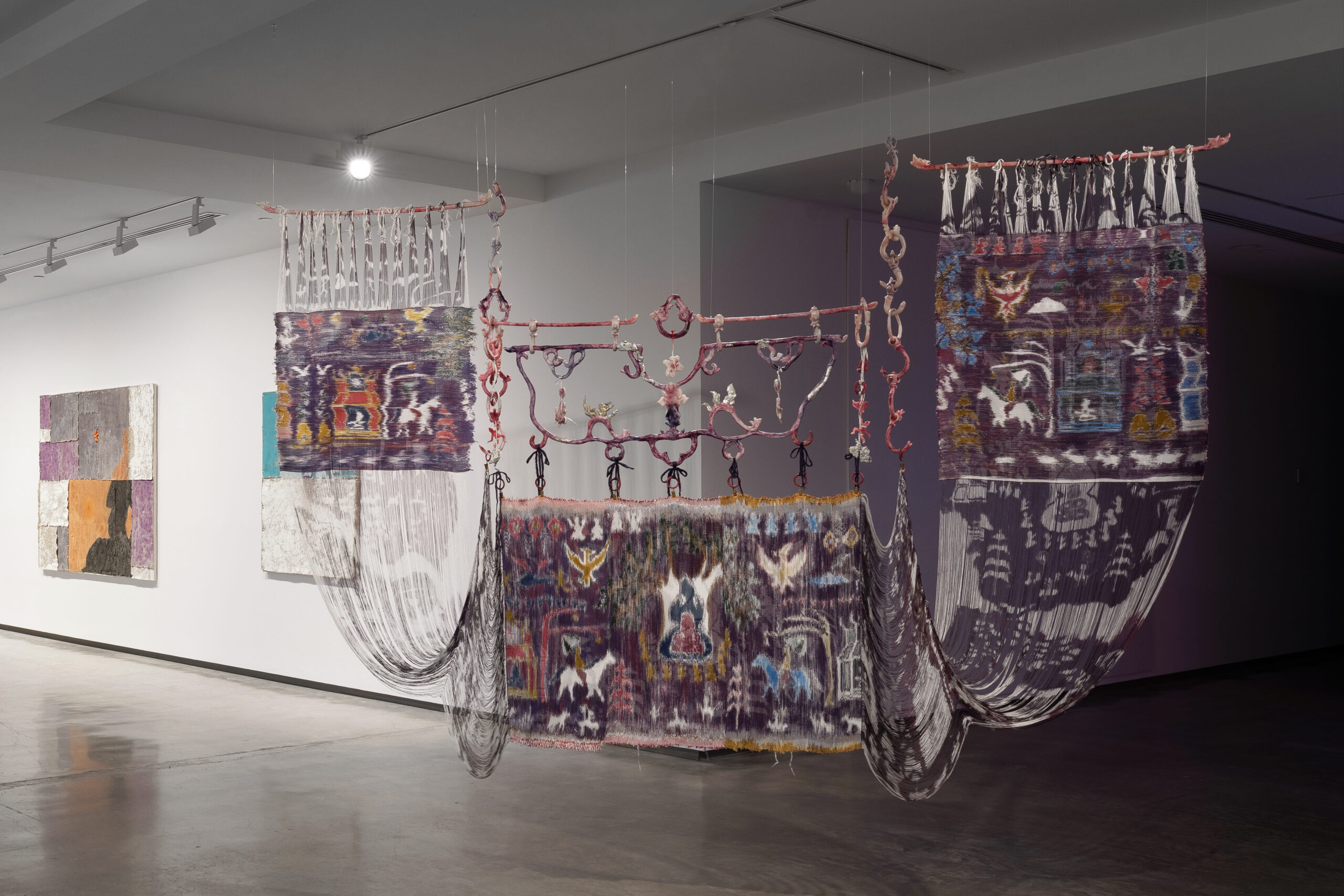
Primavera is interested in history, memory and the archive. Why do you think those ideas feel particularly present for young Australian artists right now?
Over the past few years, there has been an international resurgence of practices that grapple with history, memory and the archive. I think this is partly connected to the COVID-19 lockdowns, the way they forced us all inward – think of people going through their attics or garages, revisiting things they’d been meaning to organise or clear out for years. The pandemic also coincided with major social movements that put questions of representation and power at the top of the agenda, which naturally involve an historical perspective on the conditions of the present. I think the convergence of these forces has been felt locally in different ways and has intersected with existing preoccupations in contemporary Australian art. For several of the artists in Primavera 2026, I would also say that unprecedented levels of online access to historical material around the world, through large-scale digitisation programs, has influenced their work.
That said, I think these are eternal themes – artists have been grappling with the past, with memory, for thousands of years – and of course archive-based practices have a long history. I believe in the power of eternal themes. To some extent, I do feel there’s very little that’s truly new under the sun; we just come at enduring preoccupations differently from our vantage point in time. I would say that sensibility is shared by many of the artists.
You visited artists across the country while developing the exhibition. What were you looking for in those studio visits, and what did you find that you weren’t expecting?
I was looking for depth in an artist’s practice – not a single stand-out work, but a deep, considered practice that had evolved over many years. Many of the artists in this year’s Primavera are presenting new work in the context of a broader body of work they have developed over a longer period. Rudi Williams’ photographic installation In the air we breathe spans over a decade, from 2012–2026. Jahkarli Felicitas Romanis’ video work Skin to Skin is grounded in her project (Dis)connected to Country, which she began in 2019, while Linda Sok’s monumental silk weaving forms part of her series Deities in Temples (2023–ongoing).
My research trip to took me to cities and regional centres across the country. The art scene in Western Australia took me by surprise – it’s experimental, collaborative, alive with irreverent observation. As one artist told me, ‘There aren’t really many opportunities over here, so you just make what you want.’ A freewheeling and open sensibility thrives over there. I loved it.

Jack Wansbrough, Meteorite Enquiries, 2026, installation view, Primavera 2026: Young Australian Artists, Museum of Contemporary Art Australia, Sydney, photograph: Jessica Maurer
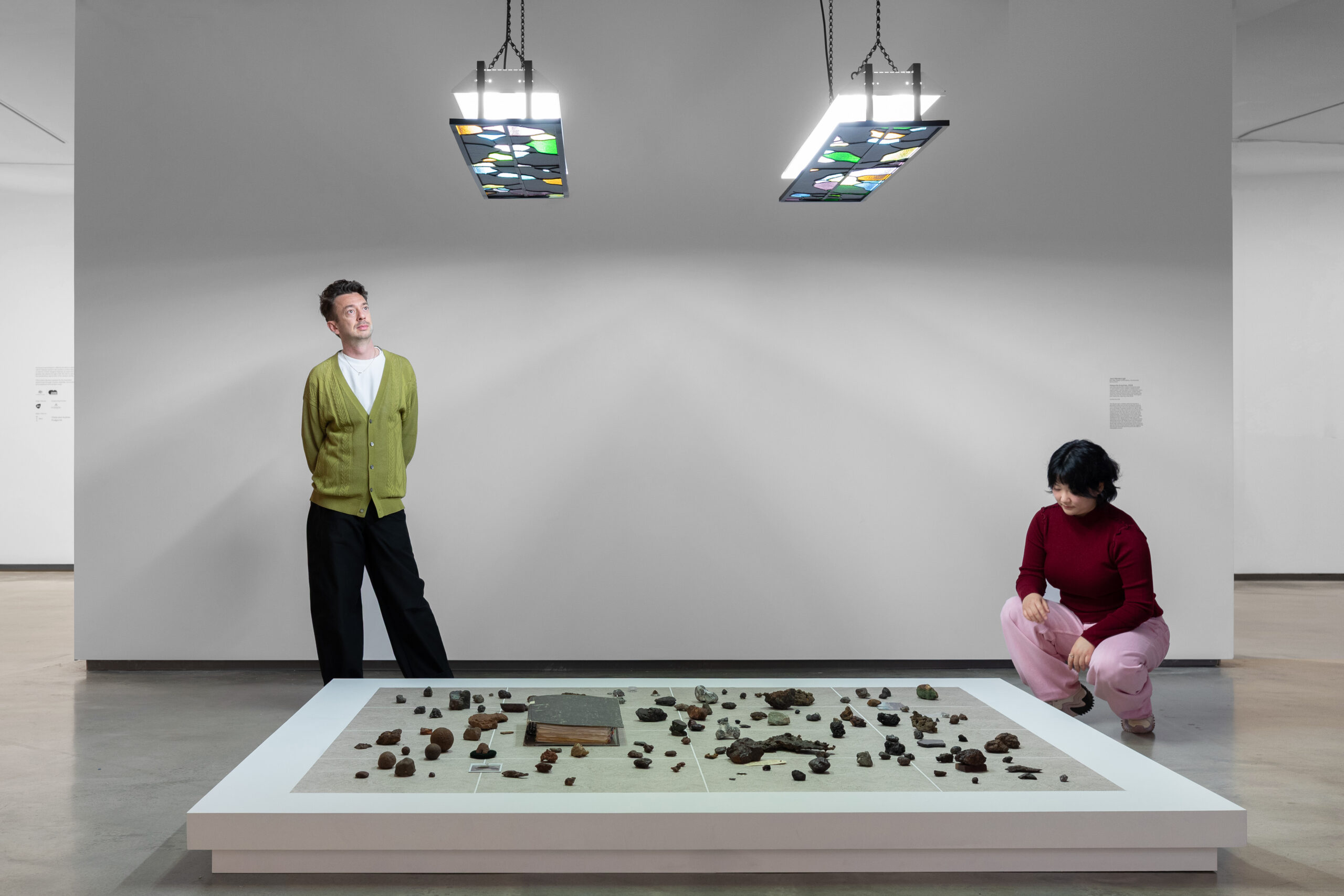
There are very different ways of engaging with the past across the exhibition. Were there particular tensions or affinities between the artists that became apparent as the exhibition took shape?
Affinities and tensions between the artists ricochet across the gallery. Stanton Cornish-Ward and Trent Crawford’s film Synchresis is at one end of the gallery and Rudi Williams’ photographic installation In the air we breathe is at the other. They take very different approaches to the broader question of technological change – Rudi’s installation is resolutely material, while Stanton and Trent’s film includes neurologically-generated and deepfaked footage – but they orbit similar questions of memory, violence and grief.
Linda Sok’s weaving Deities in Temples XXI and Jack Wansbrough’s installation Meteorite Enquiries both approach the absent (lost, discarded, destroyed) object through sculpture, and their practices are social and collaborative – Linda invited her family to contribute drawings that reverberate across her weaving, while Jack met with geologists as he developed his work. Different kinds of knowledge, contributed by other people, has flowed into both of their works, but materially and aesthetically they couldn’t be more different.

Callum McGrath, History Piece (Flagship), 2026, installation view, Primavera 2026: Young Australian Artists, Museum of Contemporary Art Australia, Sydney, photograph: Jessica Maurer
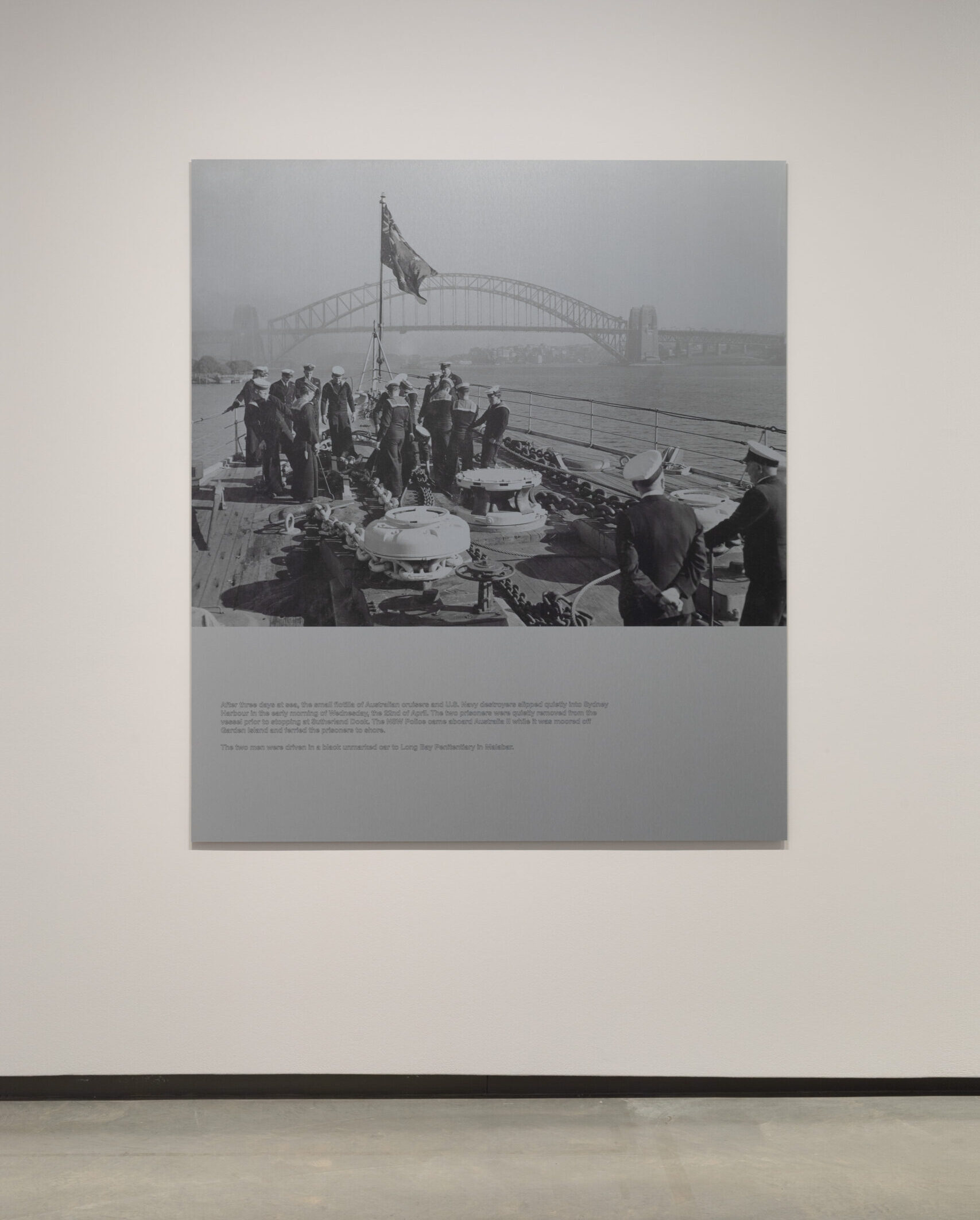
Several of the artists seem to be working with things that are intimate or deeply personal, while also opening onto much larger histories. What interests you about that movement between the personal and the collective?
I’m interested in how we are all implicated in something larger than ourselves – call it our cultural moment, the sweep of history, broader forces of social change. That movement between the personal and the collective speaks to me because I believe we are all connected, as clichéd as that sounds, and with that comes questions of ethics and responsibility. No one is an island, etc. Callum McGrath’s installation History Piece is a great example of this. The work is anchored in what Cal calls “a queer love triangle gone awry” – the murder of a young man, John ‘Jack’ Joseph Riley, aboard the HMAS Australia II in 1942 by his lovers, two fellow naval servicemen – and the far-reaching implications of John’s death. Cal finds form for those ripple effects in layers of etched glass and a two-way mirror facing onto Sydney Harbour, where the ship transported the perpetrators to Long Bay Gaol. Ultimately, his installation asks us to consider ethical questions. What does justice look like? Is it even possible? What do you think about the death penalty? What does it say about Australia in the 1940s that a man chose murder over being found out as gay, and how do we narrate these stories?
There’s a narrative drama in that movement between the personal and the collective that I’m intuitively drawn to, a sense of storytelling. Mark Maurangi Carrol’s paintings oro enua, atu enua (the horse, the lord of land) do this beautifully – he takes a cultural tradition, a horse race on a beach, and paints its passage from living memory into history, the end of an era on Avaiki Nui (the Cook Islands).
 Stanton Cornish-Ward and Trent Crawford, Calibration Sequence: Apple, 2026 and Synchresis (Part I), 2026, installation view, Primavera 2026: Young Australian Artists, Museum of Contemporary Art Australia, Sydney, photograph: Jessica Maurer
 Stanton Cornish-Ward and Trent Crawford, Calibration Sequence: Apple, 2026 and Synchresis (Part I), 2026, installation view, Primavera 2026: Young Australian Artists, Museum of Contemporary Art Australia, Sydney, photograph: Jessica Maurer
How much do the materials themselves shape the way these artists think about memory and history?
Materials have influenced the artists in different ways. Mark Maurangi Carrol’s training in traditional Cook Islander printmaking and textile practices, such as pāreu staining, has shaped his distinctive approach to painting – he pushes many layers of oil enamel into the reverse of the linen, and only part of it comes through to the front. That process, which is stubbornly material-driven, has influenced how he approaches the past. He describes it as an analogue for the loss of memory over time. But equally important in this exhibition are the archival ‘sparks’ that have informed the artists’ works, which are presented on the exhibition entrance wall. In her video Skin to Skin, Jahkarli Felicitas Romanis performs spoken word yarning to camera. She adopts the frontal and profile poses of ‘mission mugshots’ made of her great-grandmother Dolly in 1938, after she was forcibly removed from Pitta Pitta Country. Jahkarli’s installation, which features these original portraits infused with her own photographs of Pitta Pitta Country, is a tender and powerful conversation across time and place.
 Jahkarli Felicitas Romanis, Dolly, 2021, and Dolly, 2024, installation view, Primavera 2026: Young Australian Artists, Museum of Contemporary Art Australia, Sydney, photograph: Jessica Maurer
 Jahkarli Felicitas Romanis, Dolly, 2021, and Dolly, 2024, installation view, Primavera 2026: Young Australian Artists, Museum of Contemporary Art Australia, Sydney, photograph: Jessica Maurer
For visitors walking through the galleries, what is the key takeaway or shift in perspective you hope they leave with regarding how we carry history into the future?
That we are surrounded by incredibly rich stories, and that those we think we know are complex. That questions of narration, and notions of value – whether, and how, something is recorded, collected, discarded, destroyed – shape what we think we know about the past. That this partial knowledge shapes our connected human present. And that the work of artists is so generative in inviting us to reconsider our own perspectives, and inherently important. Jack Wansbrough told me that one of the fundamental instincts for his work in Primavera 2026 was a sense that “The things I can learn are worth knowing.” I like to think that animates the entire exhibition, and I hope visitors leave with that sense too.
Primavera 2026: Young Australian Artists continues at the Museum of Contemporary Art Australia, Sydney until 28 September