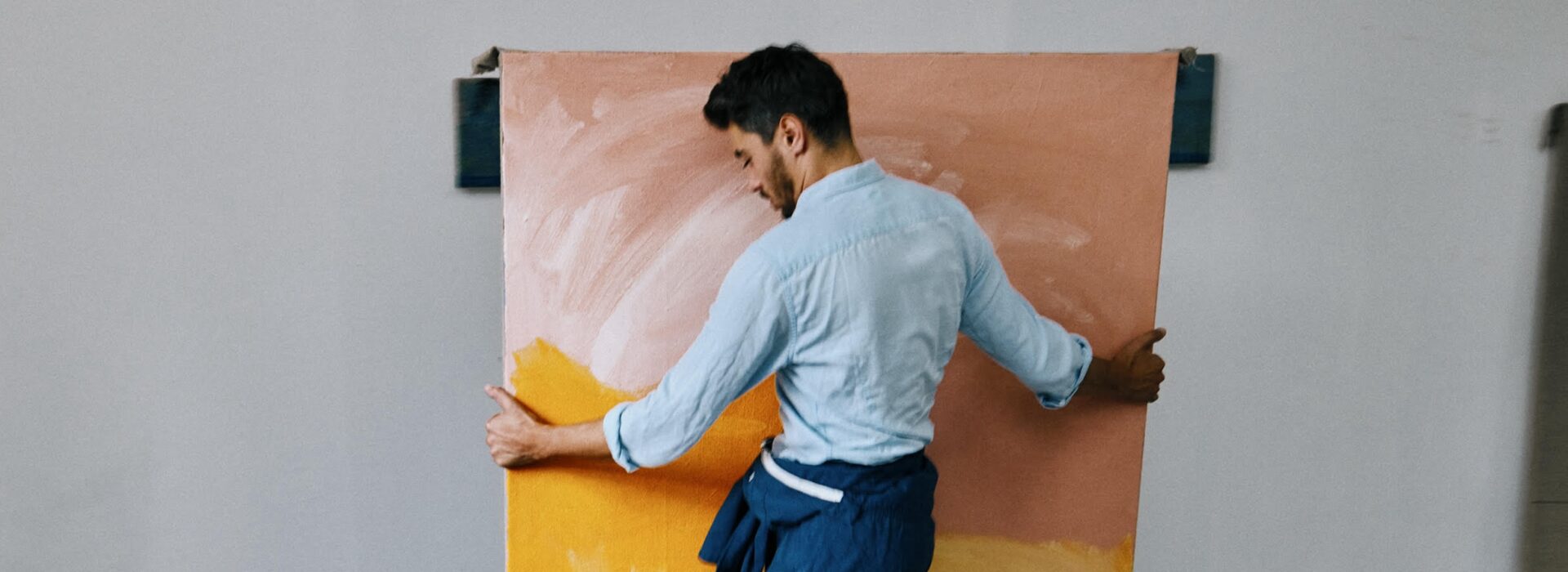
We speak with artist Mark Maurangi Carrol ahead of his upcoming presentation with Nasha Gallery in the Future sector at Sydney Contemporary. Known for his experimental use of materials and deep connection to memory and place, Carrol shares insights into his evolving practice, creative process, and what to expect from his powerful new body of work.
_
What inspired you to pursue a career in art, and how has your journey as an artist evolved over the years?
For as long as I can remember, I’ve drawn or made things—it was instinctive. Art offered a quiet space, a way to process my surroundings before I even realised that’s what I was doing. I’ve always known I wanted to create, whatever form that took. I don’t necessarily view art as a career choice, but as something intrinsic—less a conscious decision than a way of being. Over time, my practice has evolved naturally, shaped by place, experience, and dialogue.
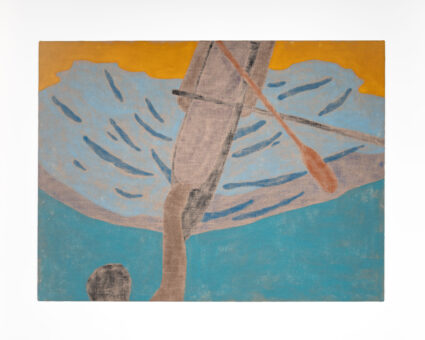
Image: Mark Maurangi Carrol, Second spring (gold), 2025, oil and permanent marker on linen, 138×183.5cm, courtesy of Nasha Gallery.
How do you approach the creative process when starting a new painting? Do you have any specific rituals or techniques?
My process often begins with research—reading, collecting images, writing, and drawing connections between memory, history, and place. I don’t have rigid rituals; while many paintings may share a similar practical inception, each one evolves differently. I spend a lot of time sitting with the linen and preparatory sketches before applying anything. Because I work on the reverse side first, I’m thinking in layers and in time, not just in terms of a “resolved” image. The act of painting becomes accumulative—more about sensing when something feels at rest than planning a finished outcome. Silence helps. I try to sit with the work for as long as possible—I believe looking is often more important to the act of making than actively building the image.
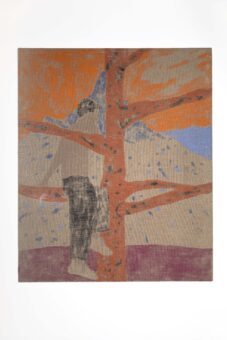
Image: Mark Maurangi Carrol, Two stories high (west), 2025, oil and permanent marker on linen, 195x162cm, courtesy of Nasha Gallery.
Your use of oil enamel on raw linen is both experimental and rooted in tradition, how did this technique evolve for you?
The use of oil enamel on linen evolved through experimentation and a desire to engage both materiality and memory. My background in printmaking and Cook Islander textile traditions like Tīvaevae and Pāreu continues to inform this approach. Painting from the reverse allows for slippages of form and pigment—the “finished” image loses resolution and becomes unstable, much like memory itself. This instability is central to the work. The loom-state linen remains active in the composition; it holds tension and absorbs traces. This method has become a way of collapsing image, material, and process.
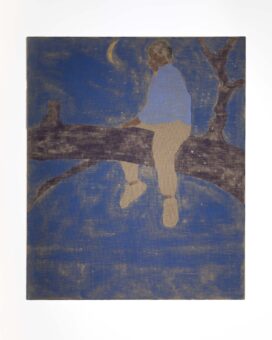
Image: Mark Maurangi Carrol, Overland (Ōkoro East), 2025, oil and permanent marker on linen, 195x162cm, courtesy of Nasha Gallery.
What can we expect to see in your presentation with Nasha Gallery at Sydney Contemporary?
At Sydney Contemporary, I’ll be presenting the third and final act of an ongoing body of work developed over the last year, exploring migration, memory, and ancestral presence through shadow and light. Titled Maru a’ia’i (“the shadows of the evening”), the presentation completes a three-part series in which shadow operates as both metaphor and material—signifying what is remembered, obscured, or carried forward.
The first act, Ueata (“to capture shadows”), was shown at Nasha Gallery earlier this year and centered on the legacy of colonial photography. That idea—photography as both a mechanism of capture and a vessel of memory (a “box of shadows”)—threads throughout the series, not only as source material, but as a conceptual lens through which to consider presence, absence, and the instability of image.
The second act, Maru a’o (“the shadows of the light of day”), opens at Lismore Regional Gallery on September 5 and considers the interplay of visibility and illumination within diasporic experience.
At Sydney Contemporary, Maru a’ia’i forms a poetic response to Maru a’o. Together, the two evoke the passage of day into night, light into shadow. This temporal arc reflects the cycles of return, reflection, and transformation that underpin my practice. The final act leans into what is fading or unresolved—a consideration of lost presence.
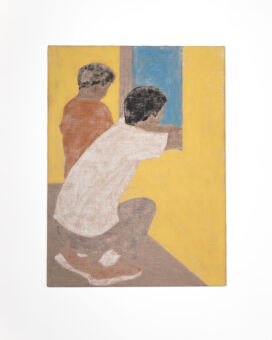
Image: Mark Maurangi Carrol, Procession, 2025, oil and permanent marker on linen, 138.5x102cm, courtesy of Nasha Gallery.
How do you imagine yourself, your practice, to look in 10 years time?
It’s a difficult question to answer, but I imagine myself still working across painting and the image in general—perhaps in more interdisciplinary ways. I’ve been engaging more consciously with sculpture and thinking about painting in an expanded sense. Since I’ve referenced tapa cloth throughout my work, I’m also interested in incorporating more traditional materials into my practice. The conceptual foundation of my work feels integral to who I am, so I imagine that core will remain. But with age and experience, I expect my responses to those ideas will evolve—shaped by time, place, and perspective.
Mark will present new work at Sydney Contemporary 2025 with Nasha Gallery. Tickets to Sydney Contemporary are on sale now.
Cover image by Volodymyr Kravchenko