
In a city where surf culture meets high culture, Michelle Grey and Susan Armstrong of Arts-Matter are helping shape Sydney’s creative identity from the inside out. With a passion for connecting people to art in meaningful ways, they offer a grounded perspective on what makes the city’s cultural life so dynamic. We caught up with them ahead of Sydney Contemporary to talk about their must-see exhibitions, favourite local spots, and why Sydney’s mix of natural beauty and artistic energy is unlike anywhere else.
__
What makes Sydney stand out as a cultural destination?
Sydney’s distinction lies in its ability to seamlessly intertwine lifestyle and culture—a combination not many cities in the world can claim. Few places in the world allow you to spend the morning riding the perfect wave, the afternoon exploring a world-class museum, and the evening indulging in some of the city’s most exciting culinary experiences. On the surface, Sydney offers the cultural institutions you’d expect—art, dance, music, and theatre—but the real richness lies just beneath. For those willing to venture beyond the obvious, the city and its surrounding regions are alive with creative discoveries: independent galleries, experimental performances, and local makers redefining what contemporary culture can be. It’s this combination of natural wonder, iconic experiences and hidden gems that makes Sydney unique.
After a day of exploring Sydney Contemporary, where would you go for dinner and drinks to continue the evening?
After a day of art consumption at Sydney Contemporary, we’d start the evening with drinks and a performance at The Vanguard. Housed in a beautifully restored Art Deco building, it offers an intimate atmosphere where live music and cabaret create a sense of timeless glamour. For dinner, we’d head to Maiz in Newtown, a contemporary Mexican restaurant that elevates the humble taco into something extraordinary—bold flavours and thoughtful presentations that perfectly capture the neighbourhood’s creative energy. To end the night, The Abercrombie is hard to resist. With its layered spaces, from rooftop terraces to buzzing dance floors, it has redefined Sydney’s late-night scene, and we’re here for it.
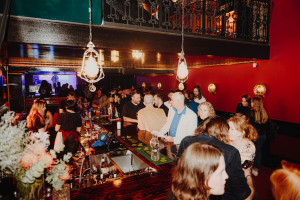
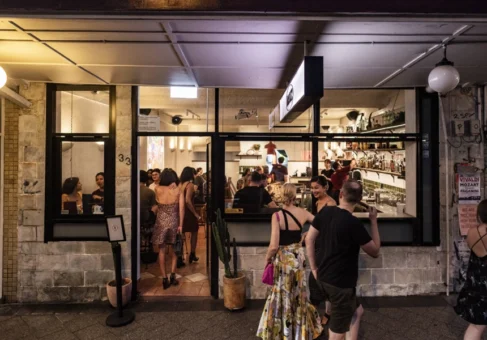
Image left: The Vanguard, image source The Vanguard. Image right: Maiz Newtown, image source Broadsheet.
What cultural events or exhibitions coincide with the Sydney Contemporary that you recommend?
We recommend checking out Renee Estee’s exhibition at COMA and Alex Seton’s new body of work at Sullivan & Strumpf—both highlight the strength and diversity of Australian contemporary practice. Over at the Art Gallery of New South Wales, Kaldor Public Art Project 38, curated by Thomas Demand, is an ambitious and thought-provoking commission that really anchors the city within an international conversation. If you’re lucky enough to secure a ticket, a performance at Phoenix Central Park is truly unforgettable—the pairing of world-class musicians with such an extraordinary architectural space makes it unlike anywhere else. And for something a little more unexpected, taking a dance class at Groove Therapy in Marrickville is a joyful way to tap into the city’s creative energy from the inside out.
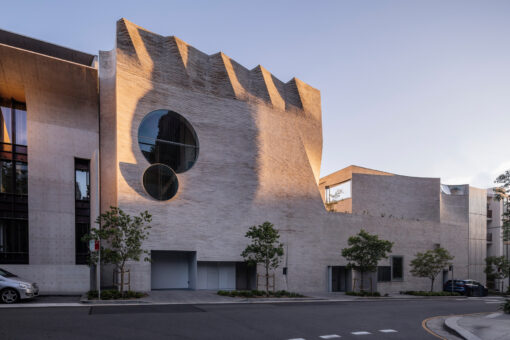
Image: Phoenix Central Park, image source The Local Project.
If you have friends visiting from outside of town, what are you adding to their itinerary?
We have so many creative friends who come to Sydney and skip the ocean. A swim at one of our incredible coastal beaches is a non-negotiable.
Do you have a favourite public art installation or mural in the city? What makes it special?
One of our favourite public art installations in Sydney has to be Louise Bourgeois’ Maman at Sydney Modern. Towering over the gallery forecourt at nine metres high, this monumental spider sculpture is both arresting and enigmatic, immediately commanding attention while inviting reflection. What makes it truly special is how it balances scale with intimacy—the imposing bronze structure evokes themes of motherhood, protection, and memory, yet its intricate details reward close inspection. Experiencing Maman in the context of the Sydney Modern, alongside Bourgeois’ deeply evocative Day and Night galleries, transforms it from a standalone sculpture into a profound encounter with emotion, architecture, and the power of contemporary art to engage both the body and the imagination.
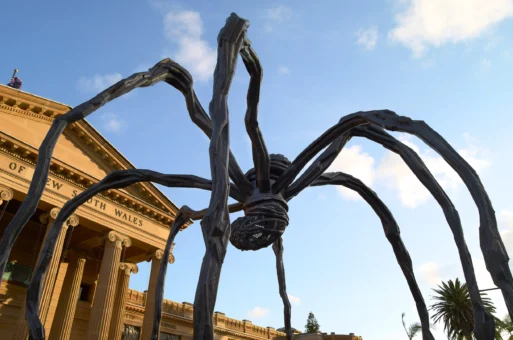
Image: Maman, Louise Bourgeois, image source Art Gallery of New South Wales.
arts-matter.com.au
@arts__matter
We spoke with Emanuel Mugrauer, Co-Founder of BTWNLNS, a book and furniture store he runs with his partner, interior architect Nicole Albrecht, and curator of the Sydney Contemporary 2025 pop-up bookshop. We discussed what makes Sydney an increasingly compelling cultural city, the importance of supporting the arts, and how to make the most of your time around the fair.
Drawing from his perspective in Berlin, Emanuel offers a candid, international view of Sydney’s creative scene—one that embraces nuance, collaboration, and a touch of unpretentious charm.
What makes Sydney stand out as a cultural destination?
Sydney has many beautiful, diverse neighbourhoods where people collaborate and contribute in their own unique ways. This makes Sydney a contemporary city in terms of art, music, food, design, architecture, and fashion. I am born and bred in Berlin, lived in Moscow, Munich, Hamburg, New York and worked worldwide. I can get inspiration from wherever I go. The interesting mix of so many cultures in Sydney feels unlike anywhere else in the world. By contrast, my hometown has never felt as diverse to me, and the quality in many areas is quite different. This vibrant patchwork creates something new, and to me, Sydney is one of the most interesting cities globally. Europe is beautiful, old, and classic. But exciting and new things are happening in Seoul, Shanghai, Taipei, Mexico City, and beyond. Hopefully, the same will be true for Sydney, as there is immense potential in the APAC region.
Those who complain about a lack of culture should start doing their part. Cities like Berlin and New York became cultural hubs because people took risks and contributed to the cultural landscape. Sydney has many interesting artists and institutions, and sometimes I feel they should be more proud and push for greater international exchange.
A funny observation is that many people from Sydney or Melbourne go to Berlin, but they haven’t really succeeded in bringing people from Berlin to Melbourne or Sydney. Some of my favourite places in Berlin are run by Australians who contribute to Berlin’s current “cool.” But they could do the same in Sydney, Melbourne, or other Australian cities. It still feels very one-sided and sometimes I wonder if Crocodile Dundee is still the reference for Australia, which is a shame. This is probably partly due to Australia’s city marketing, which tends not to focus on culture. It’s all about kangaroos, beaches, landmarks, and things like the Harbour Bridge and the Sydney Opera House (which, by the way, does a great job with its program). However, the external perception is often limited to the building itself rather than the cultural quality of its program.
Being on the other side of the world, starting fresh on another continent, makes us feel young. We have always been drawn to places that are evolving, rather than those that are already “ready-made” cool. For us, Sydney is one of the most beautiful cities in the world where you can enjoy nature and culture simultaneously.
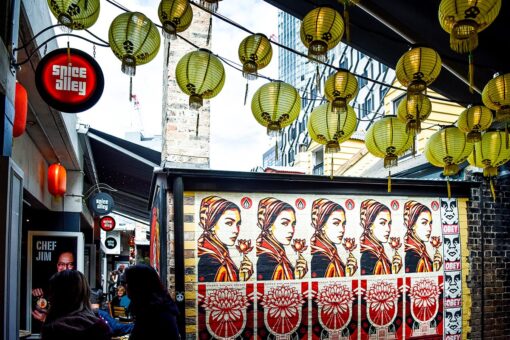
Image: Street art in Spice Alley, Image source: Scott Marsh
After a day of exploring Sydney Contemporary, where would you go for dinner and drinks to continue the evening?
Ito in Surry Hills, with its timeless, understated quality, is one of my favourite spots. Farmhouse Kings Cross, Odd Culture, and ANTE in Newtown, or Dear Sainte Eloise in Potts Point, are also fantastic. The Eveleigh Hotel in Redfern is a great choice for an outdoor beer, a “roundabout bet,” and excellent live jazz.
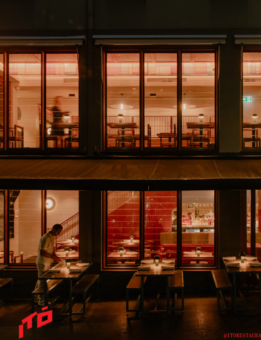
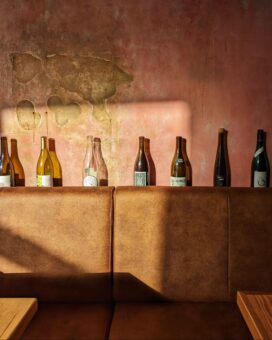
Images: Left: ITO Surry Hills, Image source: © ITO. Right: Odd Culture Newtown, Image source: Odd Culture Newtown.
What cultural events or exhibitions coincide with the Sydney Contemporary that you recommend?
I’m really looking forward to the 38th Kaldor Public Art Project. John Kaldor has invited German artist Thomas Demand to create an exhibition space in the Art Gallery of New South Wales’ Naala Badu building, specifically designed to showcase the John Kaldor Family Collection in a completely new light.
I met Thomas Demand years ago in his studio in Silverlake and was very impressed by his strong and clear artistic vision. We discussed the execution of his work “Blossom” and explored photographic techniques. “Blossom” depicts branches covered with a myriad of delicate cherry blossoms, characteristic of Sakura. Bright red sepals at the stem and pink petals frame a dark red stigma in the center. In traditional Japanese culture, because of the cherry blossoms’ short bloom, the motif symbolizes the fleetingness of life and beauty. At the same time, as a sign of spring, the blossoming trees represent new beginnings. In the end, he chose to use dye transfer prints, and I understood his decision (Even though I was keen to excite him about REANALOG—a technique combining digital photography, 3D, CGI, an 8×10 inch negative, and analogue hand-pulled C-type prints.)
That’s exactly what makes conversations with artists so rewarding—learning from their strong and clear opinions about their work.
His art and long-term collaboration with Caruso St John, showcased in the fantastic exhibitions at Berlin’s Neue Nationalgalerie and The Triple Folly, especially inspired me. His curatorial work for the Prada Foundation and the amazing exhibition “L’image volée” also had a strong impact on me.
Demand’s exhibition explores how we all rely on pre-existing models and how artists have historically drawn on existing images to create their own. The project questions the boundaries between originality, conceptual inventiveness, and the culture of copying. It examines themes of theft, authorship, appropriation, and the creative potential of such endeavours.
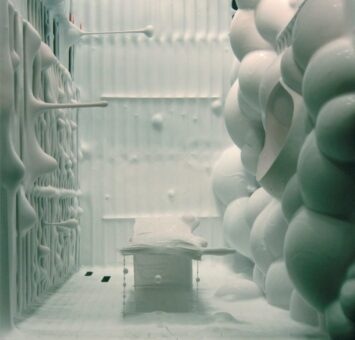
Saskia Olde Wolbers, ‘Placebo’ 2002. John Kaldor Family Collection © Saskia Olde Wolbers. Courtesy Maureen Paley, London.
If you have friends visiting from outside of town, what are you adding to their itinerary?
What do you do with your guests? Of course, we try to show them all facets and impressions of this great city. Start the morning with a dip in the ocean at Nielsen Park or Camp Cove, then enjoy coffee at ÉSEU266 in Marrickville. From there, visit 1301SW and the White Rabbit Gallery. For lunch, head to Chaco Ramen in Surry Hills. After some free time, have a simple dinner at Cairo Takeaway, then catch a concert at the Enmore Theatre, finishing the night with a drink on Enmore Road. A must is to try to get tickets for a concert at Phoenix Central Park or a production by the Sydney Dance Company or Sydney Theatre Company.
If the night was a bit long, the next morning you can relax with a steam bath at Capybara Bathing and then watch a movie at the Golden Age Cinema.
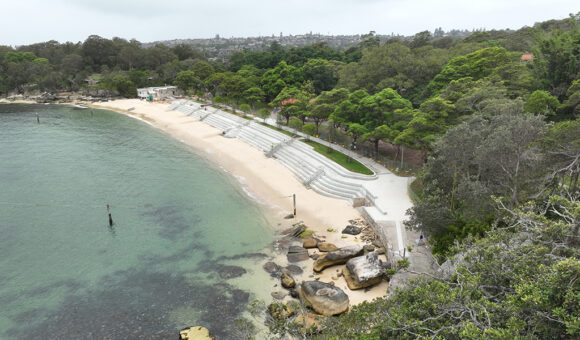
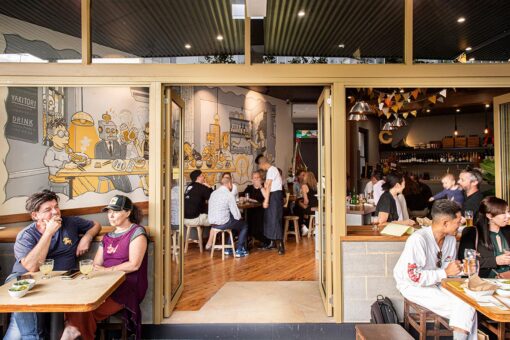
Images: Left: Nielsen Park, Image source: National Parks NSW. Right: Chaco Ramen, Image source: Chaco Ramen.
Do you have a favourite public art installation or mural in the city? What makes it special?
Honestly, I don’t know the artist’s name, but I love the “Break Up Park” bench at Burren Street Reserve in Newtown. It’s simple and effective—you don’t question it.
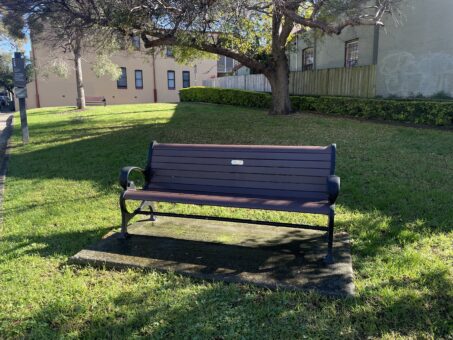
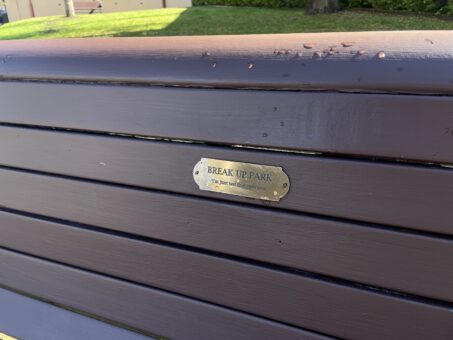
Images: “Break Up Park” bench
______
BWTNLNS will host the Pop-Up Bookshop at Sydney Contemporary 2025. Tickets to Sydney Contemporary are on sale now.
