
Loren Marks’ work radiates with a sense of intuitive energy—her layered, figurative paintings balance ambiguity and presence, memory and materiality. Ahead of her presentation with SANDERSON at Sydney Contemporary, we spoke with the Naarm/Melbourne-based artist about the ritual of daily painting, the shifting identity of her figures, and how discarded books and inner instincts guide her richly alchemical process.
_
What inspired you to pursue a career in art, and how has your journey as an artist evolved over the years?
I loved art as a child but I didn’t know where it would lead. I was lucky to get a place at the Whitecliffe College of Art and Design in Tāmaki Makaurau where I studied a Bachelor of Fine Arts. After graduating I became a surface print designer in the fashion industry. When I was working, I felt like I had all these ideas swirling around in my head and I needed an outlet, so after hours I began making my own art and then showing the pieces in random places in the city. My current gallery director at Sanderson saw the work at a pop up exhibition I put on and I was fortunate to be offered my first gallery solo show shortly after. That moment was the catalyst for me to focus on pursuing my career in art, and now I have moved to in Naarm Melbourne to complete my Masters at VCA, University of Melbourne, as a recipient of the Cranbourne Scholarship in Visual Art.
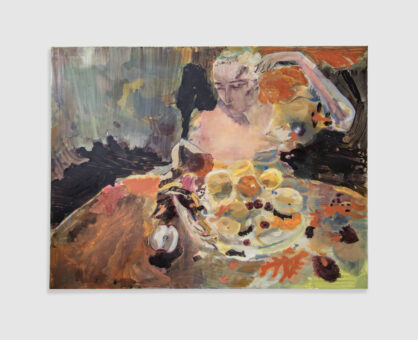
Loren Marks, As for the Rest, 2025. Courtesy of the artist and SANDERSON.
Although your process is described as intuitive and ritualistic, how do you prepare to paint, and how does that affect what appears on the canvas?
Intuition for me is very human, where sensations in my body and mind work in synchronicity to make decisions. I will start by putting paint on the surface of the canvas, which sets off a chain of events that lead to the final outcome. Sometimes the works completely change from the beginning idea. I get ideas for my works from my environment – walking around the city, looking at art, or out in nature. I sketch from my head or I’ll find photos or books that present themselves to me. I found a discarded Caravaggio book outside of my apartment that provided ideas for my current body of work. I have learnt to trust myself and the materials, and it always ends up working out if I am habitually showing up in my studio. This ritual and dedication has taught me lessons that spread out into other aspects of my life.
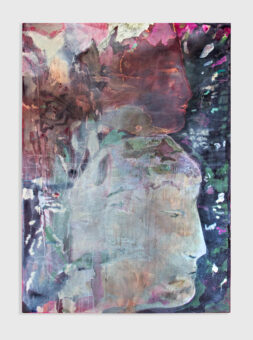
Loren Marks, On A Promise, 2024. Courtesy of the artist and SANDERSON.
Your figures are often ambiguous and shifting, what draws you to this sense of fluid identity?
Exploring the figurative is so fascinating to me, with its infinite possibilities. I want my figures to be viewed as genderless and without a specific ethnicity or identity. I want them to have a universal feeling where they transcend time and space, and you cannot place exactly where they are from. By keeping the figures ambiguous and shifting, I wish to gently invite the viewer to recognise things about themselves in them, and become part of the work too.
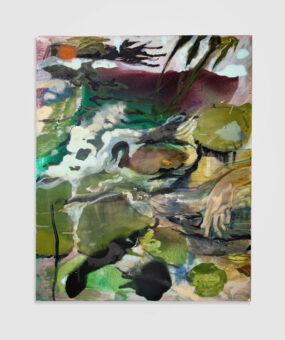
Loren Marks, Slowing of Seasons, 2025. Courtesy of the artist and SANDERSON.
With your layered, alchemical technique, how do you know when a painting is finished?
I never know when a painting is finished! But I definitely know when it’s not finished.
I sometimes bring them home from my studio and I’ll just look at them in a different space for ages and if they’re not done, they sort of annoy me or there’s just something not right and it goes back to that mind/body intuition, like the feeling of knowing that it’s not right. It’s a good sign when I don’t feel bugged by it.
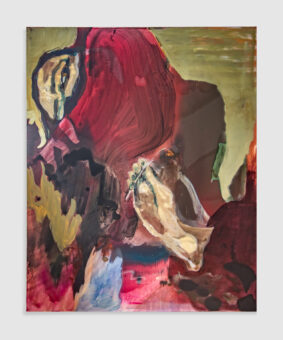
Loren Marks, I Was Able to Go This Far, 2024. Courtesy of the artist and SANDERSON.
Where do you hope to see yourself, your practice, in 10 years?
Being in new places and environments always invigorates my practice. I like to live and work either in a busy city, or deep in nature, nothing in between! I can imagine my practice evolving. With each show there is always a shift. I’m materials led so I don’t really know what my next body of work will be until I make it. What I love about art is that anything can happen, and that’s what makes it so exciting.
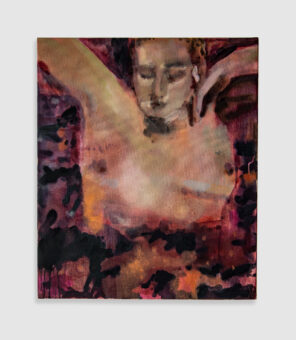
Loren Marks, Clouds in Your Eyes, 2024. Courtesy of the artist and SANDERSON.
Loren will present new work at Sydney Contemporary 2025 with SANDERSON. Tickets to Sydney Contemporary are on sale now.
We spoke with Emanuel Mugrauer, Co-Founder of BTWNLNS, a book and furniture store he runs with his partner, interior architect Nicole Albrecht, and curator of the Sydney Contemporary 2025 pop-up bookshop. We discussed what makes Sydney an increasingly compelling cultural city, the importance of supporting the arts, and how to make the most of your time around the fair.
Drawing from his perspective in Berlin, Emanuel offers a candid, international view of Sydney’s creative scene—one that embraces nuance, collaboration, and a touch of unpretentious charm.
What makes Sydney stand out as a cultural destination?
Sydney has many beautiful, diverse neighbourhoods where people collaborate and contribute in their own unique ways. This makes Sydney a contemporary city in terms of art, music, food, design, architecture, and fashion. I am born and bred in Berlin, lived in Moscow, Munich, Hamburg, New York and worked worldwide. I can get inspiration from wherever I go. The interesting mix of so many cultures in Sydney feels unlike anywhere else in the world. By contrast, my hometown has never felt as diverse to me, and the quality in many areas is quite different. This vibrant patchwork creates something new, and to me, Sydney is one of the most interesting cities globally. Europe is beautiful, old, and classic. But exciting and new things are happening in Seoul, Shanghai, Taipei, Mexico City, and beyond. Hopefully, the same will be true for Sydney, as there is immense potential in the APAC region.
Those who complain about a lack of culture should start doing their part. Cities like Berlin and New York became cultural hubs because people took risks and contributed to the cultural landscape. Sydney has many interesting artists and institutions, and sometimes I feel they should be more proud and push for greater international exchange.
A funny observation is that many people from Sydney or Melbourne go to Berlin, but they haven’t really succeeded in bringing people from Berlin to Melbourne or Sydney. Some of my favourite places in Berlin are run by Australians who contribute to Berlin’s current “cool.” But they could do the same in Sydney, Melbourne, or other Australian cities. It still feels very one-sided and sometimes I wonder if Crocodile Dundee is still the reference for Australia, which is a shame. This is probably partly due to Australia’s city marketing, which tends not to focus on culture. It’s all about kangaroos, beaches, landmarks, and things like the Harbour Bridge and the Sydney Opera House (which, by the way, does a great job with its program). However, the external perception is often limited to the building itself rather than the cultural quality of its program.
Being on the other side of the world, starting fresh on another continent, makes us feel young. We have always been drawn to places that are evolving, rather than those that are already “ready-made” cool. For us, Sydney is one of the most beautiful cities in the world where you can enjoy nature and culture simultaneously.
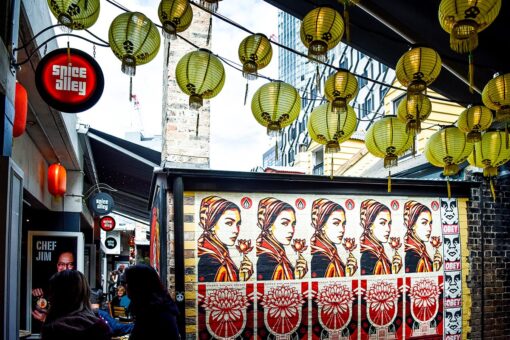
Image: Street art in Spice Alley, Image source: Scott Marsh
After a day of exploring Sydney Contemporary, where would you go for dinner and drinks to continue the evening?
Ito in Surry Hills, with its timeless, understated quality, is one of my favourite spots. Farmhouse Kings Cross, Odd Culture, and ANTE in Newtown, or Dear Sainte Eloise in Potts Point, are also fantastic. The Eveleigh Hotel in Redfern is a great choice for an outdoor beer, a “roundabout bet,” and excellent live jazz.
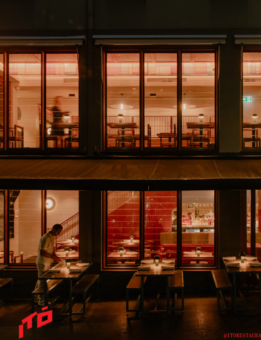
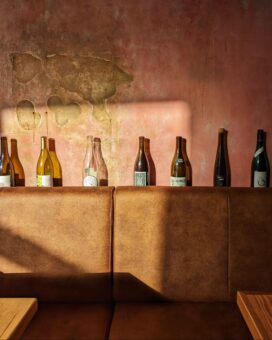
Images: Left: ITO Surry Hills, Image source: © ITO. Right: Odd Culture Newtown, Image source: Odd Culture Newtown.
What cultural events or exhibitions coincide with the Sydney Contemporary that you recommend?
I’m really looking forward to the 38th Kaldor Public Art Project. John Kaldor has invited German artist Thomas Demand to create an exhibition space in the Art Gallery of New South Wales’ Naala Badu building, specifically designed to showcase the John Kaldor Family Collection in a completely new light.
I met Thomas Demand years ago in his studio in Silverlake and was very impressed by his strong and clear artistic vision. We discussed the execution of his work “Blossom” and explored photographic techniques. “Blossom” depicts branches covered with a myriad of delicate cherry blossoms, characteristic of Sakura. Bright red sepals at the stem and pink petals frame a dark red stigma in the center. In traditional Japanese culture, because of the cherry blossoms’ short bloom, the motif symbolizes the fleetingness of life and beauty. At the same time, as a sign of spring, the blossoming trees represent new beginnings. In the end, he chose to use dye transfer prints, and I understood his decision (Even though I was keen to excite him about REANALOG—a technique combining digital photography, 3D, CGI, an 8×10 inch negative, and analogue hand-pulled C-type prints.)
That’s exactly what makes conversations with artists so rewarding—learning from their strong and clear opinions about their work.
His art and long-term collaboration with Caruso St John, showcased in the fantastic exhibitions at Berlin’s Neue Nationalgalerie and The Triple Folly, especially inspired me. His curatorial work for the Prada Foundation and the amazing exhibition “L’image volée” also had a strong impact on me.
Demand’s exhibition explores how we all rely on pre-existing models and how artists have historically drawn on existing images to create their own. The project questions the boundaries between originality, conceptual inventiveness, and the culture of copying. It examines themes of theft, authorship, appropriation, and the creative potential of such endeavours.
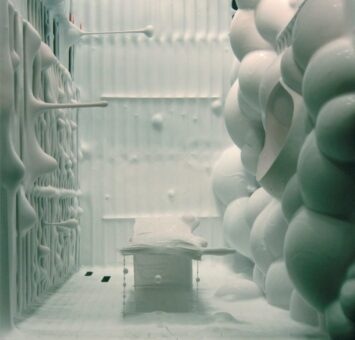
Saskia Olde Wolbers, ‘Placebo’ 2002. John Kaldor Family Collection © Saskia Olde Wolbers. Courtesy Maureen Paley, London.
If you have friends visiting from outside of town, what are you adding to their itinerary?
What do you do with your guests? Of course, we try to show them all facets and impressions of this great city. Start the morning with a dip in the ocean at Nielsen Park or Camp Cove, then enjoy coffee at ÉSEU266 in Marrickville. From there, visit 1301SW and the White Rabbit Gallery. For lunch, head to Chaco Ramen in Surry Hills. After some free time, have a simple dinner at Cairo Takeaway, then catch a concert at the Enmore Theatre, finishing the night with a drink on Enmore Road. A must is to try to get tickets for a concert at Phoenix Central Park or a production by the Sydney Dance Company or Sydney Theatre Company.
If the night was a bit long, the next morning you can relax with a steam bath at Capybara Bathing and then watch a movie at the Golden Age Cinema.
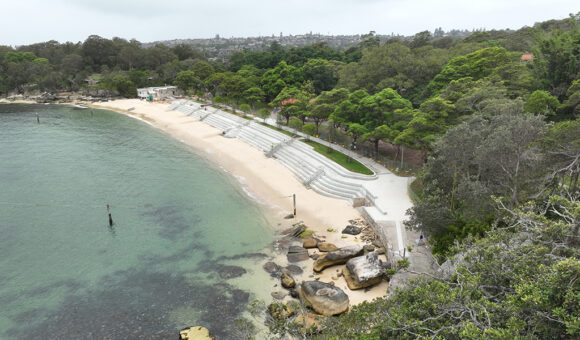
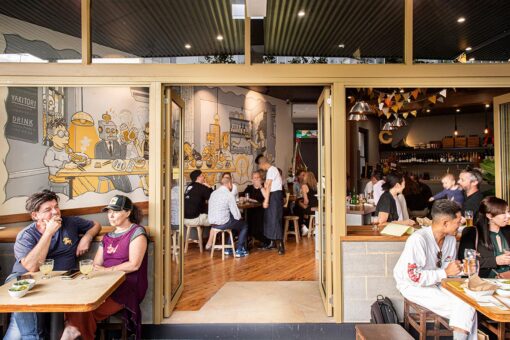
Images: Left: Nielsen Park, Image source: National Parks NSW. Right: Chaco Ramen, Image source: Chaco Ramen.
Do you have a favourite public art installation or mural in the city? What makes it special?
Honestly, I don’t know the artist’s name, but I love the “Break Up Park” bench at Burren Street Reserve in Newtown. It’s simple and effective—you don’t question it.
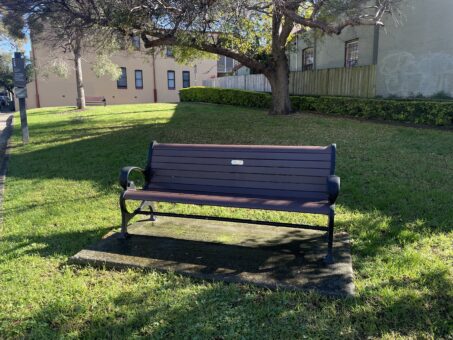
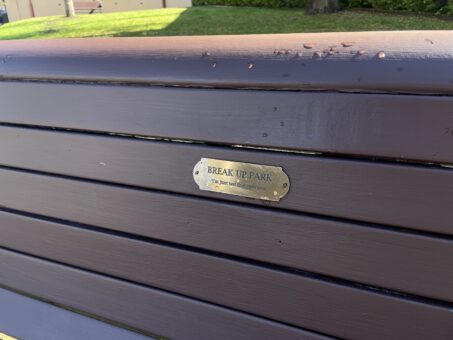
Images: “Break Up Park” bench
______
BWTNLNS will host the Pop-Up Bookshop at Sydney Contemporary 2025. Tickets to Sydney Contemporary are on sale now.
Ahead of Sydney Contemporary 2025, we spoke with Rachael Fry, Director of C. Gallery, about the gallery’s conceptual roots, curatorial focus, and what audiences can expect from their upcoming presentation. Evolving from Criteria’s design foundations, C. Gallery occupies a distinct space that bridges collectible design and contemporary art, highlighting practices that challenge category, craft, and cultural narrative. “C. Gallery developed as an extension of Criteria, integrating both physically and conceptually with the existing collection,” Fry explains.
___
Can you tell us about how C. Gallery came into existence?
C. Gallery developed as an extension of Criteria, integrating both physically and conceptually with the existing collection. It functions as a complementary platform to Criteria’s enduring commitment to collectible design, while simultaneously interrogating and blurring the boundaries between established collecting categories. This approach more accurately reflects the nuanced sensibilities and evolving aesthetic preferences of Australia’s discerning art and design community.
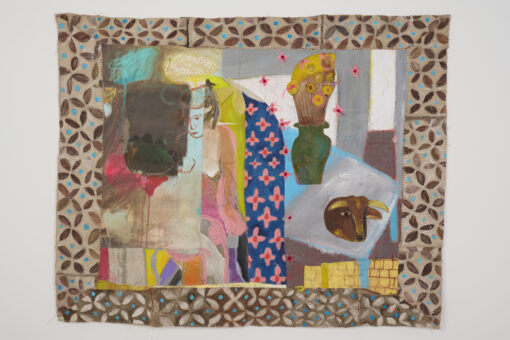
Nic Fern, ‘Ariadne’, 2025. Courtesy of the artists and C. Gallery. Photo by Joshua Morris.
Which artists are you presenting at Sydney Contemporary and why?
We are presenting new works by Nic Fern and Claudia Lau. In exhibiting two female Australian artists, we seek to highlight the differences and parallels between contemporary practices; both which draw from a deep historical knowledge and tradition while pushing their mediums in unexpected directions.
Nic Fern’s work offers a profound exploration of contemporary Australian notions of gender, class, and hierarchy. Through a diverse range of media including painting, drawing, stitching, and hand-built clay elements, she creates intricate wall works and illustrated vessels that cleverly incorporate iconic imagery from the Western visual art canon.
Claudia Lau’s practice straddles between experimentation and the refined. She seeks to explore the ceramic process expanded through a lens of poetic gesture, working with considered studio methodologies that flex between known and unexpected firing outcomes. Dividing her practice and time between a studio practice and a production studio based in Jingdezhen, China, this cultural exchange has developed her deep connection with the tradition of ceramics and experimental production methods.
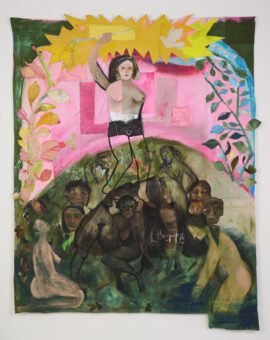
Nic Fern, ‘Liberty Leading the People’, 2025. Courtesy of the artists and C. Gallery. Photo by by Joshua Morris.
Could you share one of the most memorable times you’ve had working as a gallerist?
There’s something uniquely thrilling about witnessing an artist’s work during the installation of an exhibition. Even after seeing the full arc—from early concepts and sketches to preview imagery and final photography—the work never feels entirely real until it takes its place in the physical space. Understanding the immense effort that goes into developing a cohesive body of work only deepens the excitement when it’s finally ready to be shared with the world. It’s a feeling that never gets old.
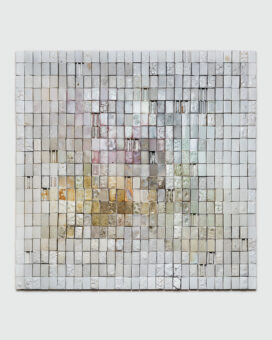
Claudia Lau, ‘Index 1’, 2024. Courtesy of the artists and C. Gallery. Photo by Simon Strong.
Looking ahead, what are your hopes for the next 10 years of C. Gallery?
I hope that our exhibitions will continue to surprise, resonate with, and deeply engage those who encounter it. It is a privilege to share the works of the remarkable artists we represent—each of them bringing a unique perspective to the cultural landscape.
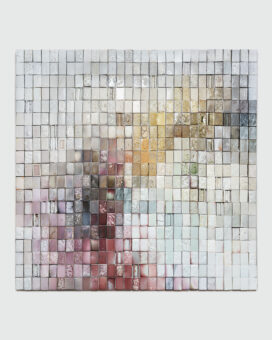
Claudia Lau, ‘Index 2’, 2024. Courtesy of the artists and C. Gallery. Photo by by Simon Strong.
______
C. Gallery will present work by Claudia Lau and Nic Fern at Sydney Contemporary 2025. Tickets to Sydney Contemporary are on sale now.
Cover photo by Sean Fennessy
cgallery.com.au
@cgallerycontemporary
In the lead-up to Sydney Contemporary 2025, we spoke with Jack Willet, Director of 1301SW, about the gallery’s evolving philosophy, memorable moments in his curatorial journey, and what visitors can expect from their upcoming presentation. Rooted in an ongoing dialogue between context and concept, 1301SW continues to push the boundaries of exhibition-making, with new work that engages deeply with both material and idea. As Willet puts it, “1301SW has an innate curiosity in exploring the diverse concepts of its artists… developing an exhibition program of changing agency: states of consistency and deviation, familiarity and inconclusiveness.”
___
How would you characterize the philosophy of 1301SW as a gallery?
It is both multi-pronged and concise. Being gently attached to its sister galleries in Los Angeles and Auckland, this connection to the larger artworld is immensely beneficial, but the gallery has also created its own vision and language, one chiefly concerned with the context it provides its artists. I see 1301SW having an innate curiosity in exploring the diverse concepts of its artists and through its larger output, which has seen us develop an exhibition program of changing agency: states of consistency and deviation, familiarity and inconclusiveness.
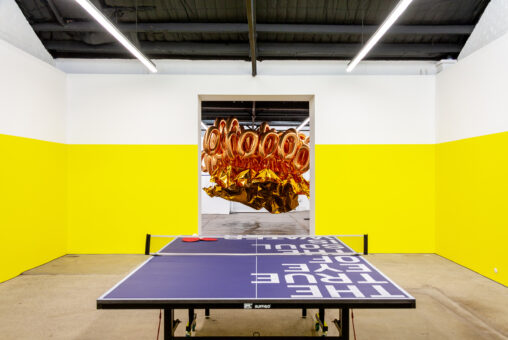
Lime and limpid green, a second scene (Part One), 2024 (installation view). Courtesy of 1301SW.
Could you share one of the most memorable moments you’ve had working as a gallerist?
The most memorable moments are over meals with artists, where a kind of dance with discourse and dialectics unfold over full plates and flowing glasses. Seeing glimmers of new ideas, existing ones needing to be massaged, and most importantly the removal of art as a topic, talking to other subjects and interests which inevitably find themselves in the work.
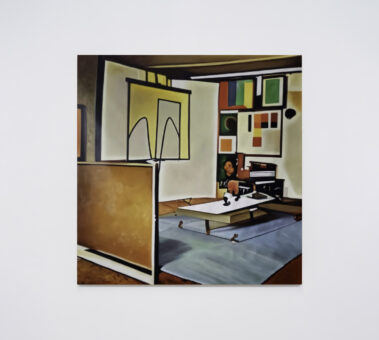
Diena Georgetti, The Civilization of the Abstract, 2025. Courtesy of the artists and 1301SW.
What are you most excited about for Sydney Contemporary 2025?
We will be presenting new aspects and developments by some of our artists at Sydney Contemporary, including a new work from Diena Georgetti which further deepens her collage-like engagement with AI, in combination with her own unique way of painting. This work collides technology, research (obsession), scale, space, form and figure into a remarkable — and sizable — painting in three distinctive yet cohesive sections. Also, outside of our booth in the project space, Jonny Niesche is undertaking the next iteration of his immersive installations which utilise a stretched mirror film, sound and vibrations to further warp our perception of his already hazy paintings.
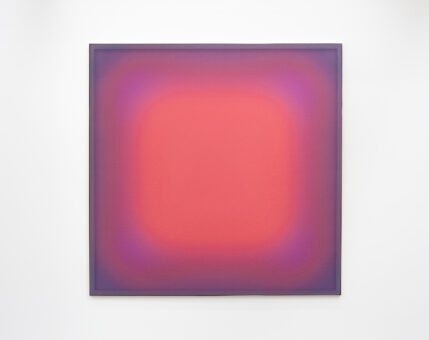
Jonny Niesche, We take infinity into our lungs (for G.B.), 2024. Courtesy of the artists and 1301SW.
Looking ahead, what are your hopes for the next 10 years of 1301SW?
Consistency and change.
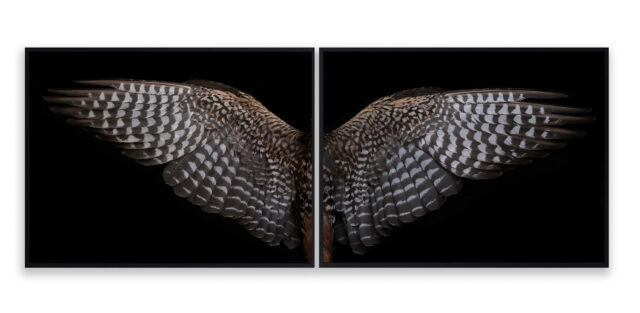
Fiona Pardington, Kārearea (below), Hunter, 2024. Courtesy of the artists and 1301SW.
1301SW | STARKWHITE will present work by Andrew Beck, Diena Georgetti, Heather Straka, Jonny Niesche, Jelena Telecki, Tim Bučković, Fiona Pardington, and Bill Hensonat Sydney Contemporary 2025. Tickets to Sydney Contemporary are on sale now.
1301sw.com
@1301sw_au
starkwhite.co.nz
@starkwhite
We speak with artist Mark Maurangi Carrol ahead of his upcoming presentation with Nasha Gallery in the Future sector at Sydney Contemporary. Known for his experimental use of materials and deep connection to memory and place, Carrol shares insights into his evolving practice, creative process, and what to expect from his powerful new body of work.
_
What inspired you to pursue a career in art, and how has your journey as an artist evolved over the years?
For as long as I can remember, I’ve drawn or made things—it was instinctive. Art offered a quiet space, a way to process my surroundings before I even realised that’s what I was doing. I’ve always known I wanted to create, whatever form that took. I don’t necessarily view art as a career choice, but as something intrinsic—less a conscious decision than a way of being. Over time, my practice has evolved naturally, shaped by place, experience, and dialogue.
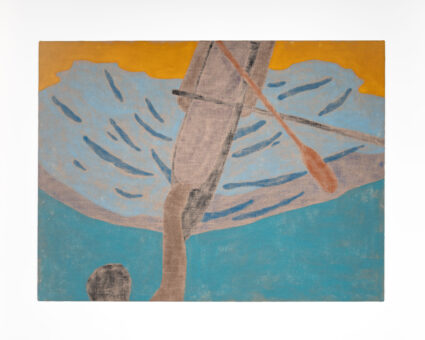
Image: Mark Maurangi Carrol, Second spring (gold), 2025, oil and permanent marker on linen, 138×183.5cm, courtesy of Nasha Gallery.
How do you approach the creative process when starting a new painting? Do you have any specific rituals or techniques?
My process often begins with research—reading, collecting images, writing, and drawing connections between memory, history, and place. I don’t have rigid rituals; while many paintings may share a similar practical inception, each one evolves differently. I spend a lot of time sitting with the linen and preparatory sketches before applying anything. Because I work on the reverse side first, I’m thinking in layers and in time, not just in terms of a “resolved” image. The act of painting becomes accumulative—more about sensing when something feels at rest than planning a finished outcome. Silence helps. I try to sit with the work for as long as possible—I believe looking is often more important to the act of making than actively building the image.
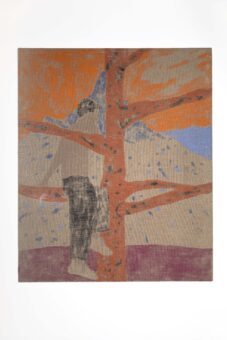
Image: Mark Maurangi Carrol, Two stories high (west), 2025, oil and permanent marker on linen, 195x162cm, courtesy of Nasha Gallery.
Your use of oil enamel on raw linen is both experimental and rooted in tradition, how did this technique evolve for you?
The use of oil enamel on linen evolved through experimentation and a desire to engage both materiality and memory. My background in printmaking and Cook Islander textile traditions like Tīvaevae and Pāreu continues to inform this approach. Painting from the reverse allows for slippages of form and pigment—the “finished” image loses resolution and becomes unstable, much like memory itself. This instability is central to the work. The loom-state linen remains active in the composition; it holds tension and absorbs traces. This method has become a way of collapsing image, material, and process.
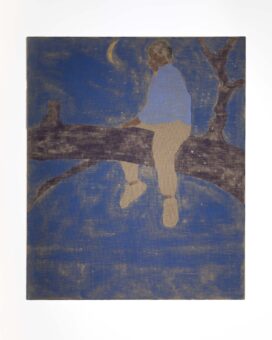
Image: Mark Maurangi Carrol, Overland (Ōkoro East), 2025, oil and permanent marker on linen, 195x162cm, courtesy of Nasha Gallery.
What can we expect to see in your presentation with Nasha Gallery at Sydney Contemporary?
At Sydney Contemporary, I’ll be presenting the third and final act of an ongoing body of work developed over the last year, exploring migration, memory, and ancestral presence through shadow and light. Titled Maru a’ia’i (“the shadows of the evening”), the presentation completes a three-part series in which shadow operates as both metaphor and material—signifying what is remembered, obscured, or carried forward.
The first act, Ueata (“to capture shadows”), was shown at Nasha Gallery earlier this year and centered on the legacy of colonial photography. That idea—photography as both a mechanism of capture and a vessel of memory (a “box of shadows”)—threads throughout the series, not only as source material, but as a conceptual lens through which to consider presence, absence, and the instability of image.
The second act, Maru a’o (“the shadows of the light of day”), opens at Lismore Regional Gallery on September 5 and considers the interplay of visibility and illumination within diasporic experience.
At Sydney Contemporary, Maru a’ia’i forms a poetic response to Maru a’o. Together, the two evoke the passage of day into night, light into shadow. This temporal arc reflects the cycles of return, reflection, and transformation that underpin my practice. The final act leans into what is fading or unresolved—a consideration of lost presence.
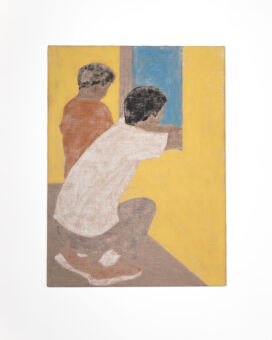
Image: Mark Maurangi Carrol, Procession, 2025, oil and permanent marker on linen, 138.5x102cm, courtesy of Nasha Gallery.
How do you imagine yourself, your practice, to look in 10 years time?
It’s a difficult question to answer, but I imagine myself still working across painting and the image in general—perhaps in more interdisciplinary ways. I’ve been engaging more consciously with sculpture and thinking about painting in an expanded sense. Since I’ve referenced tapa cloth throughout my work, I’m also interested in incorporating more traditional materials into my practice. The conceptual foundation of my work feels integral to who I am, so I imagine that core will remain. But with age and experience, I expect my responses to those ideas will evolve—shaped by time, place, and perspective.
Mark will present new work at Sydney Contemporary 2025 with Nasha Gallery. Tickets to Sydney Contemporary are on sale now.
Cover image by Volodymyr Kravchenko
Sydney is many things – beautiful, ever-changing – but for artist Ramesh, it’s the layers of culture and community that make it truly special. In this conversation, he shares his take on what makes the city such a rich place to experience art, food, and everyday magic. From Western Sydney’s creative energy to the small restaurants and hidden public artworks that stay with you, Ramesh shows us a version of Sydney that’s personal, textured, and full of life. Ramesh is represented by Sullivan+Strumpf.
_
What makes Sydney stand out as a cultural destination?
Sydney is layered, chaotic, and physically amazing. But what makes it stand out is the way multiculturalism has enriched our cultural life. There’s a resistance to a singular narrative. The meaningful integration of migrant and First Nations art, culture, and cuisine makes it an incredible place to experience, even in short bursts. In terms of art, food, and culture, there’s the polished, institutionally-driven metropolitan scene. But there’s also a wildly energetic current that flows through Western Sydney, where I grew up. I can’t wait to see how Powerhouse Parramatta takes shape, Parramatta was my stomping ground as a teenager.
After a day of exploring Sydney Contemporary, where would you go for dinner and drinks to continue the evening?
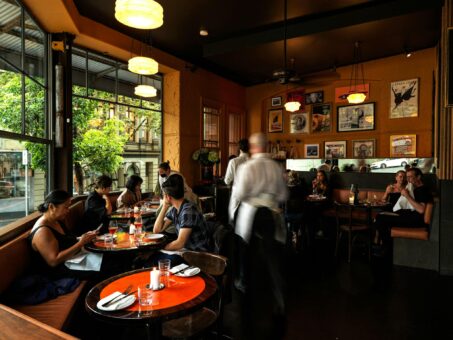
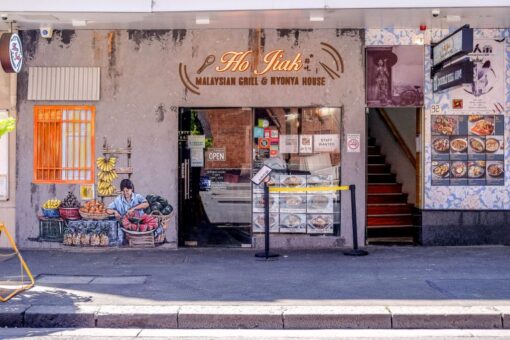
Sydney is gastronomically privileged. After a sensory overload at the fair, I’d decompress somewhere that feels generous, romantic, and unfussy. If you want to stay in Redfern, I’d head to Flyover Fritterie, Bush, or Fontana. If you venture nearby into Surry Hills or the CBD, Ace Hotel, Pellegrino 2000, or Porkfat usually get me going. That said, I love a homestyle eatery! Close by, Ho Jiak, Malacca Straits, Medan Ciak, and Caysorn Thai are some of my favourites. Cantina OK! is also a great vibe for cocktails, some of their drinks feel like storied artworks.


Images: Left: Pellegrino 2000, Image source: Broadsheet. Right: Ho Jiak, Image source Ho Jiak.
What cultural events or exhibitions coincide with Sydney Contemporary that you recommend?
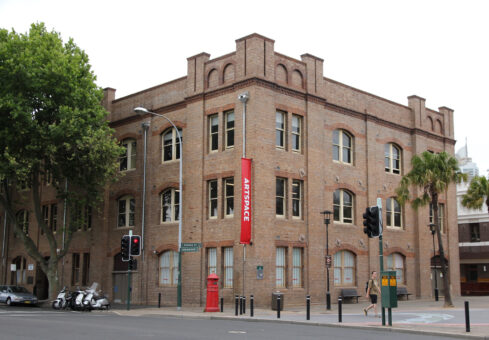
Many galleries, museums, and multi-arts centres roll out engaging programs during this period. They take advantage of the critical mass of people from all over who descend on the city. Definitely check out the major museums, but also head to venues like Artspace, Sydney, to get a sense of contemporary art in a non-commercial or collecting context. The Sydney Contemporary program itself is pretty fab. I’d recommend their tours of artists’ studios, these are the spaces where art is dreamed and made into reality. You’ll get to see the heart, the joy, the mess, the agony of process. It’ll make art feel human.

Image: Artspace, Image source MGNSW
If you have friends visiting from outside of town, what are you adding to their itinerary?
I make them leave the CBD and experience culture through food and art. Get on a train and head to Harris Park! Or head to Chef Ceylon, my favourite Sri Lankan restaurant in Toongabbie. Consider making a trip to Western Sydney galleries like Campbelltown Arts Centre or the Liverpool Powerhouse. That said, there are some amazing fashion offerings in town too. The Song for the Mute flagship store will probably send me broke.

Image: Campbelltown Arts Centre. Image source MGNSW
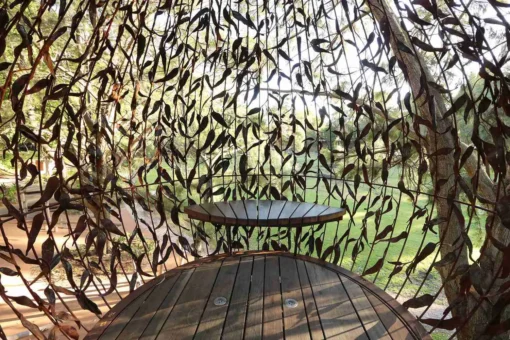
Do you have a favourite public art installation or mural in the city? What makes it special?
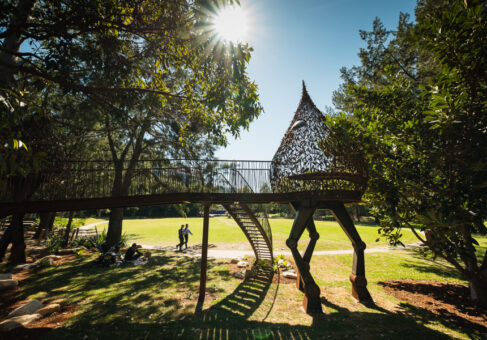
Yeah, Nell’s treehouse in Redfern sticks with me. It’s this curious, elevated structure nestled into the city like it grew there overnight from forged leaves. There’s something punk, playful, and slightly mystical about it. It doesn’t announce itself loudly. It’s not trying to dominate, but once you see it, you can’t unsee this portal or threshold. What I love about Nell’s work, there and more broadly, is how she creates space for joy, grief, humour, and spirit all at once. It reminds me that public art doesn’t have to be monumental to be powerful. It just has to shift your perspective, even for a moment.

Image: Nell’s treehouse, Redfern
Ramesh will present new work at Sydney Contemporary 2025 with Sullivan+Strumpf. Tickets to Sydney Contemporary are on sale now.
Cover image by Bowen Aricò.
ramesh-nithiyendran.com
@ramesh__mario
sullivanstrumpf.com
@sullivanstrumpf
Sam Watson-Wood, Performance Contemporary program curator and Director of Friends with Strangers, shares the artworks she’s most looking forward to seeing at Sydney Contemporary 2024.
1 – Tennant Creek Brio – Eleanor Jawurlngali Dixon & Rupert Berthas, Black Cross, 2024, Cassandra Bird
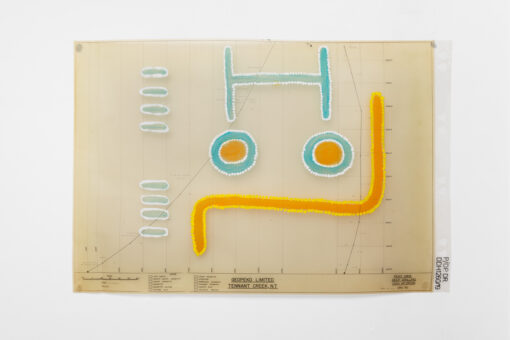
“The collective’s work addresses the ongoing tensions between Indigenous and settler cultures, revitalises traditional practices, and celebrates community resilience, all while drawing from deeply personal, multigenerational experiences. I find the graphic nature of their work engaging, urgent, playful and genius.”
2 – Adele Warner, What you see in others (exists in you), 2024, Minerva

“Warner’s work holds alienation, nostalgia, and intimacy, presenting an uncomfortable synthesis of a hybrid online/offline world. It explores both disconnection and connection. It is personal and visceral.”
3 – Suzann Victor, Prismatic River 2022, Gajah Gallery
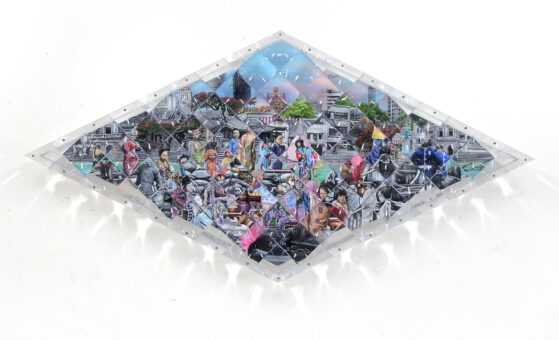
“Victor’s ‘Lens-Painting Series’ reimagines early colonial postcards of Southeast Asia. The works are intricate hand-painted compositions placed beneath lenses. It is like peering into a river, the view obscured; providing a kaleidoscope of scenes that breaks up the invasive gaze.”
4 – Shan Turner Carroll, Bodies on a Rock, 2022, COMA
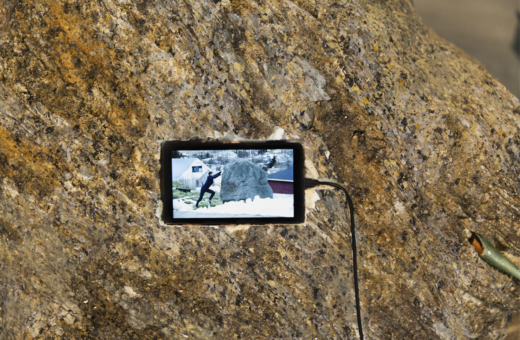
“Turner-Carroll, explores the hidden realms of knowledge and exchange, queering and questioning the intricate relationships between humans, nature, and art itself. I have read his work can sing to snakes, serenade and signal with aliens, and barter with islands, rivers, and oceans and I believe it.”
5 – Stanislava Pinchuk, The Wine Dark Sea, 2021, Ames Yavuz
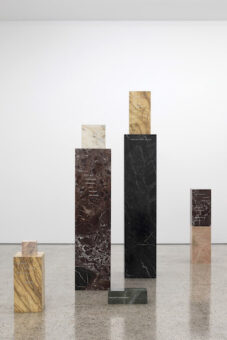
“This work is from a series called “the Wine Dark Sea” Pinchuk intertwines language from Australian offshore detention center reports with Homer’s Odyssey, using marble sculptures to highlight shared themes of exile and displacement. I love how she creates these elegant monoliths to stand as monuments of truth.”
6 – Darrell Sibosado, Galalan at Gumiri, 2023-24, N.Smith Gallery
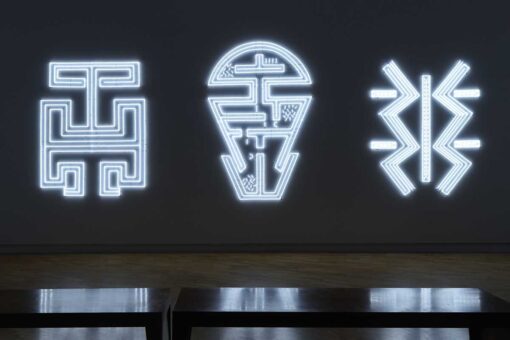
Sibosado is a Bard man from Lombadina situated on the Dampier Peninsula of the Kimberley coast. He makes Riji, or ancient pearl shell designs into modern light sculptures and installations that echo the glistening scales of the Rainbow Serpent on the Ocean. A few years ago I stayed in Lombadina and when I see these works I remember that place and imagine a serpent on the intense turquoise water.
Conversation with John Cruthers, Director of 16albermarle Project Space.
Tell us about how 16albermarle Project Space came into existence?
In 2013 I attended the first Sydney Contemporary and was blown away by the work I saw at the nine galleries from southeast Asia, and the gallerists and artists I met. I went home and said to my wife that the southeast Asian art was more interesting than Australian art. We started travelling in the region learning about the art and after 5 years we knew enough to start 16albermarle Project Space.
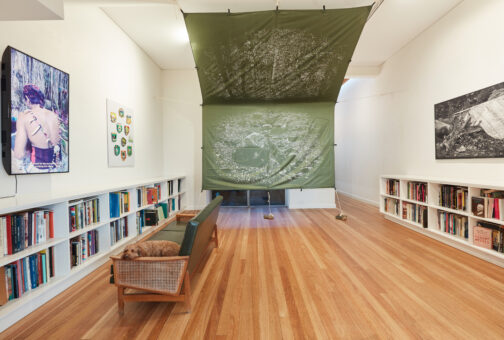
Installation View – Tanah/Land exhibitions, Surajate Tongchua and Maryanto
Could you share one of the most memorable times you’ve had working as a gallerist?
I always really enjoyed helping people find ways into art, whether it’s from Indonesia, Thailand, Cambodia, Myanmar, Singapore etc. Mostly the art is lively and people are engaged, but when there’s a little bit of context and information really helps. Once clients start learning, many of them come on our annual art study tours to meet the artists and learn more. We go to Indonesia in June each year, and Thailand in December.
Tell us about the artist/s you’re showcasing at this year’s Fair?
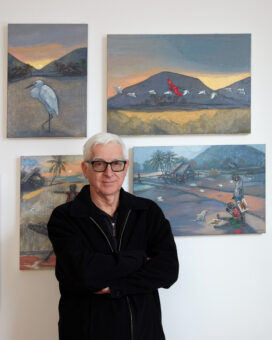
We have six younger and mid-career artists from Jogjakarta and Bali – painter Arwin Hidayat, batik artist Dias Prabu, painter Popok Tri Wahyudi and his partner performance artist and painter Agnes Christina, graphic (drawing) artist Radetyo Itok and printmaker Kadek Dwi Darmawan.
What’s happening next in the world of 16albermarle Project Space?
After five years of being mainly an exhibition space, we are rebalancing to put more emphasis on other activities – art study tours (Cambodia is being added in 2025), art fairs, exhibition development and touring, residencies and representing southeast Asian artists within sectors including interior design, architecture, fashion and public art. We want to be a one-stop shop for people wanting to connect with southeast Asian art.
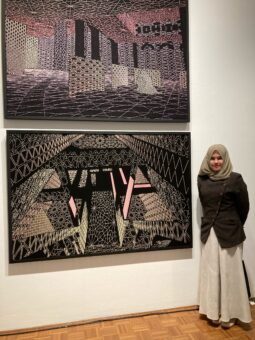
Mariem Chant, Other Possible Worlds.
Learn more about 16albermarle Project Space here.
Conversation with Alexandra Donohoe Church, Managing Director and Founder of Decus.
Can you share insights into your journey, background, and the path that brought you to founding Decus and where you are today?
My journey into interior design began serendipitously during my first year at UNSW. Initially studying Landscape Architecture, I realised my creative path lay within the built environment and switched my focus to Interior Architecture. Growing up multi-culturally, having lived in the US during my childhood before returning to Australia, greatly influenced my view of the world. My childhood in the US and global sourcing trips have inspired me deeply. I’m particularly drawn to the ethos of Mid-Century Brazilian designers, blending a humanistic approach to form, balance, and texture in my work. My designs are characterised by refined curation, whimsical detailing, and provocative combinations of finish. The Global Financial Crisis (GFC) certainly contributed to being retrenched from my practice at the time and was the push I needed to go out on my own. This period gifted me grit, tenacity, and an understanding of what it takes to create something you’re proud of from scratch.
Why do you feel the intersection of art, architecture and design hold such significance?
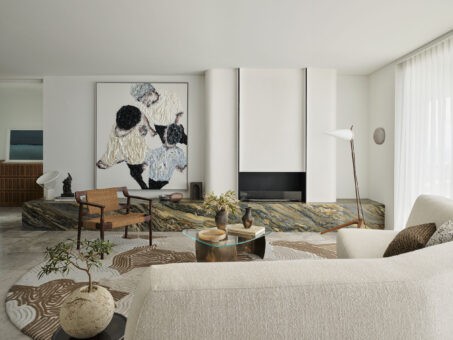
Because nothing is in a silo, each is altered by the other. It’s connective. A piece of art isn’t just a standalone object it is a unique perspective based on experience and/or perception, it engages in a conversation with its surroundings, other artworks, and the environment in which it resides. The intersection of art, architecture, and design is significant because it creates a visual rhythm within a space between different forms of creative expression. When these elements are thoughtfully integrated, they elevate each other, transforming spaces into immersive environments that evoke emotion, inspire thought, debate and questions that enrich our lives. The interplay of these disciplines reflects the human experience, blending aesthetic beauty with functionality and shaping how we perceive and interact with the world around us and the spaces we live in.
How does contemporary art align with the design ethos of Decus?
We see art as a crucial element that bridges the gap between the design concept and the personal narratives of the spaces we create. My journey with art began in tandem with my journey into design. Art is a vital component that brings depth and meaning to a space. We view art as a dynamic force that interacts with its surroundings. This dialogue creates environments that are deeply reflective of the individuals who inhabit them. Contemporary art, with its evolving nature and ability to evoke emotion, perfectly complements our approach to design, where every element is thoughtfully curated to resonate with the people and the purpose of the space.
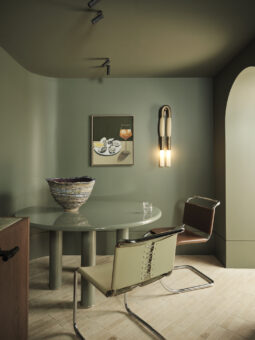
Can you tell us about the inspiration behind the design concept for The Mezzanine Lounge at Sydney Contemporary this year?
The inspiration behind the design concept for The Mezzanine Lounge at Sydney Contemporary this year was to create a compact and immersive antidote to the frantic energy of the fair. We envisioned a singular space that envelops visitors like a womb, offering refuge from below. We wanted the entry to evoke the sophistication of an iconic nightclub, with every surface thoughtfully covered in rich textures. The design transitions seamlessly from day to night, ensuring an unparalleled sanctuary for relaxation and exclusivity.
How does Decus approach balancing functionality and aesthetic appeal in its designs, particularly in a space like The Mezzanine?
We design for our clients, who have complex, unique needs. It’s why all of our projects look so different. We spend a lot of time with our clients fully understanding their brief and how they live in a space, this process ensures that the functionality of the spaces suits every aspect of a client’s home life.
In a similar fashion we really wanted to understand the purpose of the Mezzanine space rather than starting just with a creative concept. As a result, we’ve managed to create a versatile space, allowing for the array of events and clients that the fair be hosting within it.
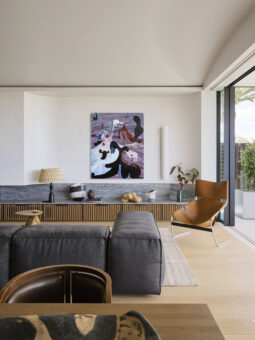
What trends or innovations in interior design do you see emerging in spaces designed for hospitality and cultural events like Sydney Contemporary?
Immersive spaces that transport people in a visceral or physically sensory way, as opposed to an environment that is ticking a series of practical and functional boxes.
Learn more about award-winning interior design studio Decus.
We spoke with Gallery co-director, Riley Davison from NAP Contemporary to talk about their presentation for Sydney Contemporary 2024.
How do you characterize the philosophy of NAP Contemporary as a gallery?
There’s such a scarcity of private galleries in regional Australia who try and engage with contemporary art in a meaningful way. Our ambition was to bring new voices in pacific art to our growing regional city. Our philosophy is to create a space for artists to extend their practices to a new level, and to give them exposure to a collector base here and overseas. We sometimes invite recent art school graduates to exhibit with us, we also showcase mid and late career artists from across the country and abroad.
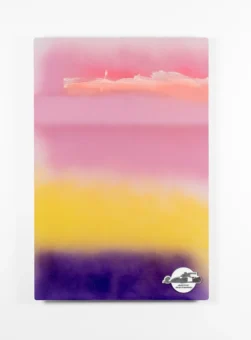
Scott Redford, Auto Rothko (Pink), 2024. Courtesy of the artist and NAP Contemporary.
You have been working in galleries for 3 years. What’s special about the gallery world for you?
When Erica Tarquinio and I opened NAP just 3 years ago we had no gallery experience, everything we know has been learned in that time, often through making mistakes and looking to other new galleries, also ARI’s, for inspiration. Prior to opening the gallery, we both worked for many years for indigenous art centres, and so our experience is largely from the other side of the sector, the benefit of that being we understand artist advocacy. Entering the gallery world has been a learning curve for us, and since then we have enjoyed working with many great artists, collectors and curators in a short time. Working alongside creative people on a full-time basis is such a privilege and we have been proud to contribute to the gallery scene and felt a warm reception to our emergence.
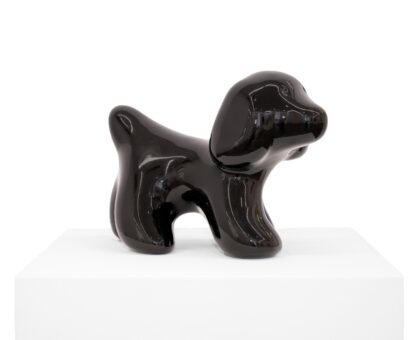
Scott Redford, Puppy, 2024. Courtesy of the artist and NAP Contemporary.
What are you most excited about for your first time exhibiting at Sydney Contemporary?
We first visited the fair in 2022, we were astounded by the scale and vibrancy of it and honestly at that time I don’t think we even imagined being able to participate! It was working with Scott Redford over the past year or so that we realised it would be the perfect platform for an artist of his significance and vision. It will be our first solo presentation at a fair, and it’s a thrill to really bring something of national significance – and with a generous dose of fun. At many will know, Scott has been exhibiting since 1983 with major exhibitions at NGV, ACMI, AGSA, AGNSW, GOMA including international shows, amassing 8 dedicated publications. His new work is really a knockout, and we are thrilled to showing at Sydney Contemporary.
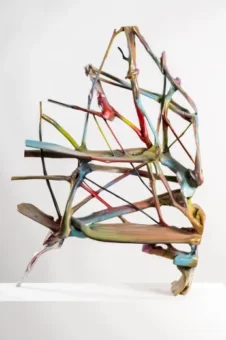
Scott Redford, Made by Unknown Artist. Bought on Facebook marketplace and painted by Dipit Kustoms, Geebung, Brisbane, 2024. Courtesy of the artist and NAP Contemporary.
What advice would you give someone looking to start their own collection at the fair this year?
Heading into a fair like Sydney Contemporary you can’t help being overwhelmed by the variety of offerings. Starting a collection is a very personal thing of course, I believe in shortlisting works which resonate with you, and then diving a little deeper, with your own research and/or the guidance of a gallerist. In retrospect your first piece is always going to be special, but an early acquisition of an important work is a great cornerstone to a collection. I think it’s the role of a gallerist to offer guidance in terms of the kinds of value a particular artist or artwork can add to a collection. A new collection is an exciting journey, a good one embodies the perspective of the owner and represents a certain moment in art history. Come have a chat with Erica and I at booth J01.
Learn more about NAP Contemporary
