
Jemima Wyman transforms protest smoke into an immersive textile, considering camouflage, collective action and the political charge of pattern.
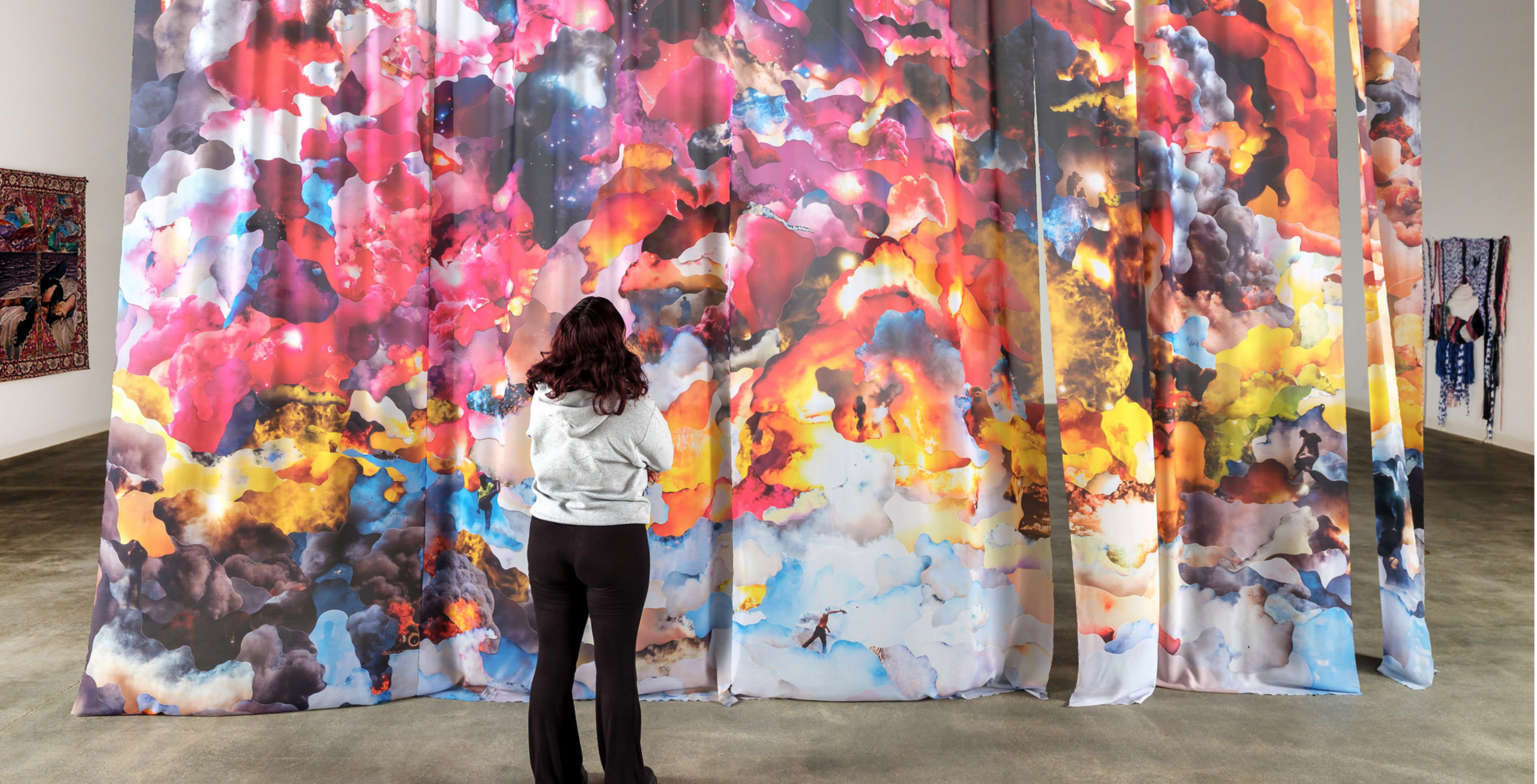
Jemima Wyman’s Haze 18, 2025, is a custom-printed curtain derived from the artist’s hand-cut photographic collages of smoke clouds generated at protests around the world. The expanded title includes details about each piece of smoke pictured: the type (of smoke), protest, place, date and colour, comprising 3949 words. Described by Wyman as an “ideological textile”, Haze considers how fabric can carry political meaning through its associations with propaganda, camouflage, protest attire and conflict. Suspended in space, the curtain becomes both image and atmosphere: seductive, deceptive and tactical. It reflects on collective action, public unrest and the capacity of images to reveal, obscure and mobilise political feeling.
“I think of the Haze works as ideological textiles. They carry images of protest smoke as both warning and possibility: signs of discontent, but also a reminder of collective resilience and the hope for change.”
Jemima Wyman
About the Artist
Jemima Wyman is a Palawa artist based in Los Angeles, working across collage, photography, textiles, video, and installation. Her practice explores pattern, masking, and camouflage as visual strategies of resistance, examining how bodies, images, and political movements negotiate visibility, concealment, and collective identity.
Presented by Sullivan+Strumpf

To learn more about Jemima Wyman and this artwork, visit Sullivan+Strumpf at Sydney Contemporary, Booth C02.
Learn more sullivanstrumpf.com
Haze 18
Haze 18…(unabridged title 3949 words) (curtain) 2025 Custom-printed Chiffon (100% polyester with 100% polyester thread) 180 H x 234 W / 457 x 594cm (note: this is when the fabric is completely stretched out no folds)
Haze 18 (smoke sorted by colour and then chronologically): Smoke from burning tires during a protest against the arrest of opposition leader Ousmane Sonko (ahead of the final verdict in his trail), Dakar, Senegal, 29 May 2023 (Black [B]) (x3); Smoke from burning tires during a protest against the two-year prison sentence for “corrupting youth” given to the opposition leader Ousmane Sonko, Dakar, Senegal, 1 June 2023 (B)(x2); Smoke from burning tires during protest against the killing of five Palestinians by Israeli forces (during the raid on the city of Jenin), Gaza, Palestinian Territories, 19 June 2023 (B)(x5); Smoke from bonfire during a protest against the police killing of a 17-year-old during a traffic stop, Toulouse, France, 28 June 2023 (B); Smoke from burning car during a protest against the police killing of a 17-year-old during a traffic stop, Nanterre, France, 29 June 2023 (B); Smoke from burning cars during a protest against the police killing of a 17-year-old during a traffic stop, Paris, France, 29 June 2023 (B); Smoke from a burning hotel during a protest against the police killing of a 17-year-old during a traffic stop, Roubaix, France, 30 June 2023 (B); Smoke from burning tires mixed with tear gas during protest against Israel’s ongoing air strikes (and raids in Jenin), Gaza, Palestinian Territories, 4 July 2023 (B)(x2); Smoke from a burning barricade during a protest against the high cost of living, Nairobi, Kenya, 19 July 2023 (B); Smoke from burning barricades during a protest by Azimio la Umoja against the high cost of living, Nairobi, Kenya, 20 July 2023 (B); Smoke from burning posters in support of Iraqi Shia cleric Moqtada al-Sadr and against the burning of the Koran in Sweden, Sadr City, Baghdad, Iraq, 21 July 2023 (B); Smoke from burning tires during a protest against the cost of living and tax increases, Nairobi, Kenya, 21 July 2023 (B)(x2); Smoke from burning tires during a protest by taxi industry (SANTACO) against the City of Cape Town, 1 Cape Town, South Africa, 8 August 2023 (B); Smoke from burning tires during a protest against insecurity in Carrefour-Feuilles, Port-au-Prince, Haiti, 14 August 2023 (B); Smoke from burning car tires during a protest by the Farmers Defence Force against the new INEOS factory, Antwerp, Belgium, 18 August 2023 (B)(x2); Smoke from burning tires during a protest against the attacks by Israeli forces on Palestinians (who came to the al-Aqsa Mosque to perform prayers), Gaza, Palestinian Territories, 25 August 2023 (B); Smoke from burning tires during a protest against the (informal) meeting between Libya’s foreign minister and their Israeli counterpart (in Rome), Tripoli, Libya, 28 August 2023 (B)(x5); Smoke from burning tires during a protest against the (informal) meeting between Libya’s foreign minister and their Israeli counterpart (in Rome), Tripoli, Libya, 29 August 2023 (B); Smoke from burning tires during a protest in solidarity with Palestinian prisoners held in Israeli prisons, Gaza, Palestinian Territories, 12 September 2023 (B) (x2); Smoke from burning tires during a Palestinian protest against Israel, Gaza, Palestinian Territories, 15 September 2023 (B)(x4); Smoke from protests against burning of the Koran, Sylhet, Bangladesh, 6 August 2023 (B / Blue [Blu]); Smoke from burning building during a protest against the police killing of a 17-year-old during a traffic stop, Roubaix, France, 29 June 2023 (B / Orange [O]); Smoke from burning tires during a protest against the police killing of a 17-year-old during a traffic stop, Bordeaux, France, 29 June 2023 (B / O); Smoke from burning tires during a protest against the police killing of a 17-year-old during a traffic stop, Roubaix, France, 29 June 2023 (B / O); Smoke from burning car during a protest against the two-year prison sentence for “corrupting youth” given to the opposition leader Ousmane Sonko, Dakar, Senegal, 1 June 2023 (Grey [G])(x2); Smoke during a protest against pension reform (pushed through parliament by the government without a vote), Paris, France, 6 June 2023 (G); Smoke during protest against the killing of five Palestinians by Israeli forces (during a raid on the city of Jenin), Gaza, Palestinian Territories, 19 June 2023 (G); Smoke from burning barricades mixed with tear gas during a protest against the current government and the high cost of living, Nairobi, Kenya, 12 July 2023 (G); Smoke from a burning car during a protest by Azimio la Umoja against the high cost of living, Nairobi, Kenya, 20 July 2023 (G); Smoke from the burning Swedish Embassy during a protest in support of Iraqi Shia cleric Moqtada al-Sadr and against the planned burning of the Koran and Iraqi flag in Sweden, Baghdad, Iraq, 20 July 2023 (G); Smoke from burning barricades during a protest against the high cost of living and the current government, Nairobi, Kenya, 21 July 2023 (G); Smoke from burning tires during a protest against the high cost of living and the current government, Nairobi, Kenya, 21 July 2023 (G); Smoke from a burning bus during a protest against the Prime Minister Sheikh Hasina. Protesters also want an independent body to oversee 2024 elections, Dhaka, Bangladesh, 29 July 2023 (G); Smoke from a burning bus during a protest against the Prime Minister Sheikh Hasina. Protesters also want an independent body to oversee 2024 elections , Shonir Akhra, Dhaka, Bangladesh, 29 July 2023 (G)(x2); Flare smoke during a protest commemorating the 79th anniversary of the Warsaw Uprising, Kraków, Poland, 1 August 2023 (G)(x4); Smoke from burning property during a protest over rising power and water prices, Swellendam, South Africa, 16 August 2023 (G)(x3); Flare smoke during a protest demanding an explanation (on the second anniversary) of the untimely death of firefighter Joan Liébana, Barcelona, Spain, 17 June 2023 (G / Red [R])(x2); Smoke from burning money and flares during a protest by GreenFaith against the ongoing investment in fossil fuel corporations by JPMorgan Chase, New York, US, 14 September 2023 (G / R)(x3); Smoke from burning tires during a protest against the Israeli government’s judicial overhaul plan, Modi’in, Israel, 27 June 2023 (G / White [W]); Smoke bombs and 2 tear gas launched by police at a protest against the police shooting of Michael Brown, Ferguson, Missouri, 17 August 2014 (O); Smoke bombs during a protest against the constitutional court ruling that blocked anti-corruption, Kyiv, Ukraine, 30 October 2020 (O with white light); Flare smoke during a protest for the release of activist Sergey Sternenko, who was found guilty on charges of abduction and sentenced to 7.3years in prison, Kyiv, Ukraine, 20 March 2021 (O); Smoke from fireworks by pro-democracy protesters on the anniversary of the 2006 Military coup when the current government came to power, Bangkok, Thailand, 19 September 2021 (O); Smoke during an Extinction Rebellion protest against deaths caused by famine and natural disasters in the lead up to COP26 summit (to be held in Glasgow), The Hague, Netherlands, 11 October 2021 (O); Flare smoke during the Total Amnesty for all Political Prisoners protest, Madrid, Spain, 16 October 2021 (O); Smoke from canister during a protest against repressive laws by the ‘Anti-Repressive Movement’, Madrid, Spain, 16 October, 2021 (O); Smoke bomb during a protest by unions and workers for factory workers rights at Alcoa and Vestas, Viveiro, Spain, 17 October 2021 (O); Smoke from fireworks during a Millions Mask March protest , London, England, 5 November 2021 (O); Flare smoke during a protest against the housing crisis, The Hague, Netherlands, 14 November 2021 (O); Smoke from fire during a protest against COVID-19 restrictions and the health pass, Brussels, Belgium, 21 November 2021 (O); Smoke from burning rubbish during a protest against economic conditions, Lebanon, Beirut, 29 November 2021 (O); Flare smoke during a protest against new COVID-19 measures, Utrecht, Netherlands, 4 December 2021 (O); Smoke during an Anti-Eric Zemmour (far-right presidential candidate) protest, Paris, France, 5 December 2021 (O); Flare smoke during a protest against the governments ‘Police, Crime, Sentencing and Courts Bill (PCSC Bill)’. The bill would give police and government more powers to restrict protests, London, England, 15 January 2022 (O); Flare smoke during a protest calling for justice around violence against woman, Athens, Greece, 21 January 2022 (O); Smoke bombs used during a protest (outside the Embassy of Israel) in support of the local Palestinian community during a period of raids by Israeli soldiers at Sheikh Jarrah, London, England, 21 January 2022 (O); Smoke from flare during World Wide Rally For Freedom protest against mandatory COVID-19 vaccination for NHS staff, London, England, 22 January 2022 (O)(x3); Flare smoke during an anti-government protest against the economic and financial crisis, Lebanon, Beirut, 23 January 2022 (O)(x2); Smoke bomb during a Freedom, Democracy and Human Rights protest against COVID-19 restrictions on European countries, Brussels, Belgium, 23 January 2022 (O)(x2); Flare smoke during a protest against labour reforms, Barcelona, Spain, 29 January 2022 (O); Smoke from burning hay during a protest over price disputes by the farmers union, Le Mans, France, 15 February 2022 (light O glow); Smoke bomb used during a protest by Corsican Workers Union (STC) against extra policing reinforcements being transported, after earlier protests related to the attack on pro-independence activist Yvan Colonna, Corsica, France, 4 March 2022 (O with yellow glow); Flare smoke during a clash between police and protesters over the assault of Yvan Colonna while in prison, Corsica, France, 8 March 2022 (O); Tear gas used by police during a protest on International Women’s Day, Istanbul, Turkey, 8 March 2022 (O); Flare smoke during a clash between police and protesters over the assault of Yvan Colonna while in prison, Corsica, France, 9 March 2022 (O)(x3); Flare smoke from protesters against rising fuel prices, Brest, France, 15 March 2022 (O); Flare smoke from Yellow Vests protesters against the government and inequity, Marseille, France, 19 March 2022 (O glow over white smoke); Smoke from burning bus during a protest against the President’s inefficient handling of the financial and energy needs of the 3 country (with 13-hour plus electrical outages), Colombo, Sri Lanka, 31 March 2022 (O); Flare smoke during a protest by ‘Extinction Rebellion’ advocating: an end to the use of all fossil fuels, for governments to address the climate crisis, combat biodiversity loss, and aim for net zero carbon emissions by 2025, The Hague, Netherlands, 27 May 2023 (O); Flare smoke during a protest against the Israeli government’s judicial overhaul plan, Tel Aviv, Israel, 3 June 2023 (O); Smoke from burning hotel (being extinguished) during a protest against the police killing of a 17-year-old during a traffic stop, Roubaix, France, 30 June 2023 (O)(x2); Flare smoke during a protest by Israeli military reservists against the Israeli government’s judicial overhaul plan, Haifa, Israel, 3 July 2023 (O); Flare smoke during a protest against the Israeli government’s judicial overhaul plan, Tel Aviv, Israel, 20 July 2023 (O); Smoke from fireworks during a protest against the interim president Manuel Merino de Lama, Lima, Peru, 12 November 2020 (R/Pink [P]/Yellow [Y]); Flare smoke during a protest against the imprisonment of right-wing activist Serhii Sternenko, Kyiv, Ukraine, 20 March 2021 (R)(x2); Smoke bomb used during a protest against the Instro Precision factory and its connections to supplying weapons to the Israeli military (that are used against the Palestinian population in Gaza), Sandwich, England, 4 October 2021 (R); Flare smoke during student protest against G20 and other government policies related to social inequities and climate crisis, Rome, Italy, 29 October 2021 (R)(x2); Flare smoke during student protest against G20 and other government policies related to social inequities and climate crisis, Rome, Italy, 30 October 2021 (R)(x2); Flare smoke during a ‘Climate Justice’ protest, London, England, 6 November 2021(R); Flare smoke during a nationalist protest in support of Poland in a migrant crisis unfolding on the Belarusian-Polish border outside the Belarusian Embassy, Kyiv, Ukraine, 10 November 2021 (R); Smoke bomb during a National Corps protest in against the Kremlin, Kyiv, Ukraine, 12 November 2021 (R); Smoke during a protest by soccer fans in support of players speaking out against sexual harassment scandal in NWSL, Portland, US, 14 November 2021(R); Flare smoke during a protest against university reforms, Madrid, Spain, 18 November 2021 (R); Smoke during a protest by soccer fans in support of women players speaking out against sexual harassment scandal by former coach Paul Riley, Portland, US, 21 November 2021(R); Flare smoke used during a protest against the ban on fireworks (in order to keep hospital visit down during COVID-19), The Hague, Netherlands, 27 November 2021 (R); Flare smoke during a protest against government COVID-19 restrictions, Brussels, Belgium, 5 December 2021(R); Flare smoke during a protest against far-right presidential candidate Éric Zemmour, Paris, France, 5 December 2021 (R)(x2); Flare smoke during a protest against far-right presidential candidate Éric Zemmour, Paris, France, 5 December 2021 (R with Yellow [Y]); Smoke bomb used during a protest by CGT, Paris, France, 15 December 2021 (R); Flare smoke during “truth, freedom rally” protest against mandatory COVID-19 vaccinations for first responders and city employees, Boston, US, 5 January 2022 (R); Flare smoke during a protest against the French football league refusal to postpone a match between Girondins de Bordeaux and Olympique de Marseille, Bordeaux, France, 7 January 2022 (R)(x3); Flare smoke during a ‘Kill The Bill’ protest, Manchester, England, 15 January 2022 (R); Flare smoke at a protest in support of Petro Poroshenko (during his court hearing) Kyiv, Ukraine ,19 January 2022 (R); Flare smoke at a protest in support of Petro Poroshenko (during his court hearing) Kyiv, Ukraine ,19 January 2022 (R/Y); Flare smoke during a protest by animal rights advocates against (the pandemic risks of) factory farming , London, England, 25 January 2022 (R); Smoke bomb used during a protest against alternating schoolwork and in remembrance of Lorenzo Parelli, Rome, Italy, 28 January 2022 (R); Firework smoke during a protest 4 against government mandatory COVID-19 restrictions, Ottawa, Canada, 29 January 2022 (R); Flare smoke during a protest against pro-Russian politician Murayev and pro- Russian TV propaganda, Kyiv, Ukraine, 2 February 2022 (R); Flare smoke during a student protest in memory of Lorenzo Parelli (student killed on an unpaid internship), Turin, Italy, 4 February 2022 (R); Flare smoke during a protest for the independence for Catalonia, Barcelona, Spain, 5 February 2022 (R); Smoke during a protest by climate justice groups against a giant warehouse construction called Terra2, Toulouse, France, 9 February 2022 (R); Smoke bomb used during a student led protest against alternating schoolwork, Naples, Italy, 18 February 2022 (R); Smoke bomb used during a protest for safer work experience practices after the death of two students, Rome, Italy, 18 February 2022 (R); Flare smoke during a student protest in memory of Lorenzo Parelli (student killed on an unpaid internship) and Giuseppe Lenoci (killed in a car crash on work experience), Turin, Italy, 18 February 2022 (R)(x3); Smoke bomb used during a protest in memory of the leftist militant Valerio Verbano (killed in 1980), Rome, Italy, 22 February 2022 (R)(x3); Tear gas used by police during a protest for International Women’s Day, Istanbul, Turkey, 8 March 2022 (R); Flare smoke at a protest in support for refugees as part of United Nations Anti-Racism Day, London, England, 19 March 2022 (R)(x2); Smoke bomb used during a protest by the ‘Abolitionist Anti-Speciesist Collective’ advocating for new animal rights laws related to circuses and zoos’, Mexico City, Mexico, 24 March 2022 (R); Smoke bomb used during a Global Climate Strike protest, Rome, Italy, 25 March 2022 (R); Smoke during a transportation strike protest. Truck drivers asking for better work conditions, a fuel price decrease and the resignation of the Transportation Minister, Madrid, Spain, 25 March 2022 (R)(x5); Flare smoke during a pro-democracy protest (in remembrance of ‘The Red Shirt’ group) advocating for democracy and monarchy reformation, Bangkok, Thailand, 10 April 2022 (R); Smoke bomb during a rail-union protest advocating for a wage increase because of soaring energy prices and global inflation, Paris, France, 18 October 2022 (R); Smoke bomb during a protest in remembrance of Lola Daviet (a murdered 12-year-old), Paris, France, 20 October 2022 (R); Flare smoke during a protest against the Israeli government’s judicial overhaul plan, Tel Aviv, Israel, 3 June 2023 (R)(x2); Smoke bomb during a protest against the guilty verdict and imprisonment of the left-wing student Lina E., Leipzig, Germany, 3 June 2023 (R)(x5); Smoke during a protest against the guilty verdict and imprisonment of the left-wing student Lina E., Leipzig, Germany, 3 June 2023 (R) (x2); Smoke during a commemorative protest on the 10-year anniversary of the death of Clément Méric (an anti-fascist activist) at the hands of two far-right skinheads Esteban Morillo and Samuel Dufour, Paris, France, 4 June 2023 (R); Smoke from flare thrown at riot police by a protester against pension reform (pushed through parliament by the government without a vote), Nantes, France, 6 June 2023 (R); Flare smoke during a protest by teachers and the National Education Union (NEU) requesting a pay rise, London, England, 5 July 2023 (R); Flare smoke during a protest against the Israeli government’s judicial overhaul plan, Tel Aviv, Israel, 20 July 2023 (R); Flare smoke during a protest against the Israeli government’s judicial overhaul plan, Tel Aviv, Israel, 24 July 2023 (R); Flare smoke during a protest against the Israeli government’s judicial overhaul plan, Tel Aviv, Israel, 27 July 2023 (R); Smoke from burning car, fireworks and petrol bombs during unrest related to Brexit and Sinn Fein members attending a funeral, Belfast, Ireland, 9 April 2021 (W); Smoke from fireworks at the ‘Million Mask March’, London, England, 5 November 2021 (W); Smoke from a riot police and army drill in preparation for upcoming election campaigns, Malang, Indonesia, 31 May 2023 (W); Tear gas from Israeli soldiers during a Palestinian protest against Israeli settlements in 5 the village of Beit Dajan, West Bank, Palestinian Territories, 2 June 2023 (W); Smoke during a ‘Cannabis Liberation’ protest against hypocritical laws, Warsaw, Poland, 3 June 2023 (W)(x2); Smoke during a protest against the guilty verdict and imprisonment of the left-wing student Lina E., Saxony, Leipzig, Germany, 3 June 2023 (W)(x3); Smoke from a fire being extinguished during a protest against pension reform (pushed through parliament by the government without a vote), Paris, France, 6 June 2023 (W); Tear gas during a protest against pension reform (pushed through parliament by the government without a vote), Nantes, France, 6 June 2023 (W); Tear gas from Israeli soldiers during a Palestinian protest against Israeli settlements in the village of Beit Dajan, West Bank, Palestinian Territories, 16 June 2023 (W); Flare smoke during a protest demanding an explanation (on the second anniversary) of the untimely death of firefighter Joan Liébana, Barcelona, Spain, 17 June 2023 (W)(x2); Smoke during a protest against the police killing of a 17-year-old during a traffic stop, Paris, France, 27 June 2023 (W); Smoke from burning car during a protest against the police killing of a 17-year-old during a traffic stop, Nanterre, France, 29 June 2023 (W); Tear gas during a protest against the police killing of a 17-year-old during a traffic stop, Paris, France, 29 June 2023 (W)(x2); Tear gas from Israeli soldiers during a Palestinian protest, Gaza, Palestinian Territories, 4 July 2023 (W); Tear gas during a protest against the high cost of living and the current government, Nairobi, Kenya, 7 July 2023 (W); Smoke from burning tree branches during a protest against the Israeli government’s judicial overhaul plan, Tel Aviv, Israel, 8 July 2023 (W); Tear gas during a protest against the high cost of living and the current government, Nairobi, Kenya, 12 July 2023 (W); Smoke during a protest against the Israeli government’s judicial overhaul plan, Tel Aviv, Israel, 20 July 2023 (W); Smoke from a burning car during a protest against the high cost of living and the current government, Nairobi, Kenya, 20 July 2023 (W); Smoke from a fire being extinguished during a protest against the Israeli government’s judicial overhaul plan, Tel Aviv, Israel, 20 July 2023 (W)(x2); Smoke from burning tires and tear gas during a protest against the high cost of living and the current government, Nairobi, Kenya, 21 July 2023 (W)(x2); Tear gas during a protest against the high cost of living and the current government, Nairobi, Kenya, 21 July 2023 (W)(x3); Smoke from burning tree branches during a protest against the approval of a key clause of the Israeli government’s judicial overhaul plan, Tel Aviv, Israel, 24 July 2023 (W); Tear gas and water cannon spray used by Turkish soldiers against protestors wanting to prevent old pine-forest deforestation in order to expand a coal mining operation that supplies a local power plant, Akbelen Forest, Mugla, Turkey, 29 July 2023 (W)(x2); Tear gas used during a protest against the Military police killing of 13-year-old boy Thiago Menezes Flausino, Rio de Janeiro, Brazil, 7 August 2023 (W); Smoke from burning (prop) coffin during a protest against firefighters’ work place conditions and labor rights outside the gates of the Parliament, Barcelona, Spain, 1 September 2023 (W); Tear gas during a protest by Eritrean asylum seekers opposed to an event organized by the Eritrean Embassy, Tel Aviv, Israel, 2 September 2023 (W)(x2); Tear gas from Israeli soldiers during a Palestinian protest against the expansion of Jewish settlements in the West Bank village of Kafr Qaddum, Nablus, Palestinian Territories, 8 September 2023 (W); Tear gas from Israeli soldiers during a Palestinian protest to mark the 30th anniversary of the Oslo Accords signed between Palestine and Israel, Gaza, Palestinian Territories, 13 September 2023 (W); Tear gas from Israeli soldiers during a Palestinian protest, Gaza, Palestinian Territories, 15 September 2023 (W); Tear gas and fireworks at pro-democracy protest (on the anniversary of the 2006 military coup), Bangkok, Thailand, Sunday, 19 September 2021 (Yellow [Y]); Flare smoke at a protest against President Jair Bolsonaro COVID-19 6 policies and the increase in poverty, Belo Horizonte, Brazil, 3 October 2021 (Y); Smoke during a protest against a radical left-wing trailer park eviction, Berlin, Germany, 15 October 2021 (Y); Smoke bomb during a protest against the G20, Rome, Italy, 30 October 2021 (Y); Flare smoke during a protest for Global Day of Action for Climate Justice, Amsterdam, Netherlands, 6 November 2021 (Y); Flare smoke during a protest for Global Day of Action for Climate Justice, Amsterdam, Netherlands, 6 November 2021 (Y); Flare smoke during a ‘Together for Freedom’ protest against COVID-19 fear, Brussels, Belgium, 5 December 2021 (Y); Smoke bomb used during a protest against the TSJC ruling that 25% of classes in Catalan schools must be taught in Spanish, Barcelona, Spain, 10 December 2021 (Y); Flare smoke during a protest against the greenwashing of nuclear energy and natural gas by the EU, Frankfurt, Germany, 11 January 2022 (Y); Smoke bomb during a protest against Russian aggression, Kyiv, Ukraine, 12 February 2022 (Y); Smoke bomb during a protest (outside the Russian Embassy) against the military offensive ordered by President Vladimir Putin toward several Ukrainian cities, Mexico City, Mexico, 26 February 2022 (Y); Smoke flare during a protest against the Russian invasion in Ukraine (outside former Russian embassy), Tbilisi Georgia, 12 March 2022 (Y); Smoke bomb during a ‘Fridays For Future’ protest against government inaction in relation to climate change, Turin, Italy, 25 March 2022 (Y); Flare smoke during a protest by ‘Extinction Rebellion’ advocating: an end to the use of all fossil fuels, for governments to address the climate crisis, combat biodiversity loss, and aim for net zero carbon emissions by 2025, The Hague, Netherlands, 27 May 2023 (Y); Flare smoke during a commemorative protest on the 10-year anniversary of the death of Clément Méric (an anti-fascist activist) at the hands of two far-right skinheads Esteban Morillo and Samuel Dufour, Paris, France, 4 June 2023 (Y)(x2); Flare smoke during a protest by teachers asking for better work conditions, Barcelona, Spain, 12 June 2023 (Y) and Flare smoke during a protest against the Israeli government’s judicial overhaul plan, Tel Aviv, Israel, 18 July 2023 (Y). 7
About Installations
Installations presents ambitious contemporary art throughout Carriageworks, and for the first time, extends into the city. The program of 14 projects features sculpture, textiles, painting, photography, kinetic forms, and public interventions, with works that are generous and immediate but also ask us to look more closely at the social, ecological, and cultural systems shaping our world.
Artists use spectacle, material invention and public address to explore some of the defining questions of contemporary life: how histories inhabit place, how images circulate, how materials carry memory, and how audiences gather, move, participate and reflect. Installations is curated by José Da Silva, Director of UNSW Galleries.
