
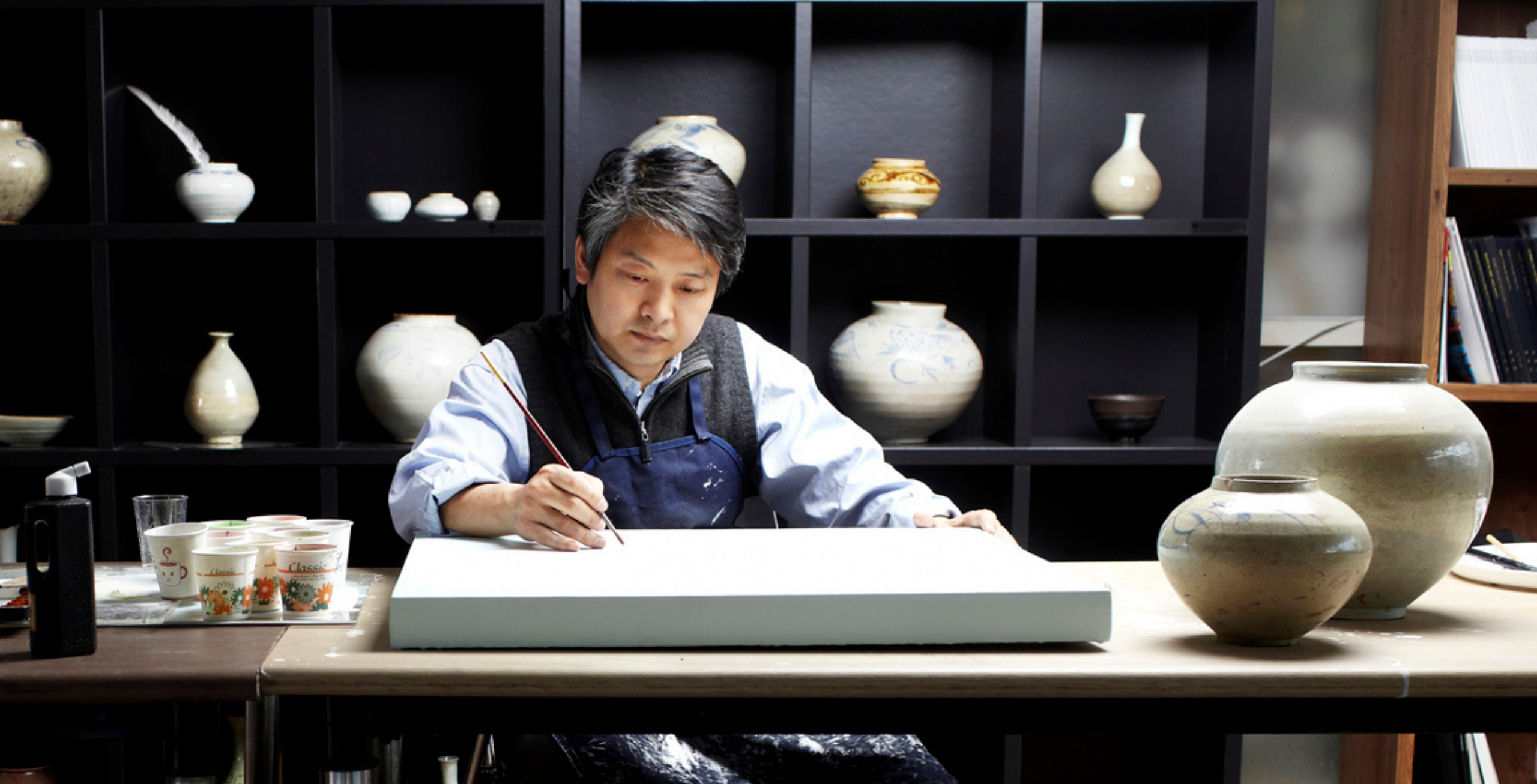

Choi Youngwook’s pavilion featuring his Moon Jar paintings offers viewers a serene retreat from the bustle of the fair.
Project <,> unfolds Choi Youngwook’s vision for an ideal encounter with his Karma series amid the bustle of an art fair. Developed in collaboration with interior design practice Studio Chen Lu, the pavilion invites fairgoers into a private engagement with three works, all of which take the white porcelain form of the Korean Moon Jar as their subject. Each is built up through a laborious process of layering and sanding with marble dust, with 80 to 100 coats applied. Facing the oak bench, the central work raises the jar’s full outline in relief, whilst two companion pieces at either side draw us in closer to the surface detail. For it is Choi’s pencil-drawn crazing and watercolour detailing which are the true occasion of these studies, transcribing the surface of the moon jar with the artist’s sustained reflection on the karmic entanglements of a human life. For viewers dwelling in this interior space, sheltered by screens of luminous fabric, Choi has a suggestion: “Recall one of your own memories while looking at my paintings and lead yourselves into them.”
“My work visualises memories as images, and they become the medium of communication. I painted my own memories, but they are also the stories of all of us. Recall one of your own memories while looking at my paintings and lead yourselves into them.”
Youngwook Choi
About the Artist
Choi Youngwook is a Korean painter who has devoted more than two decades to the white porcelain form of the Korean Moon Jar, raising its form in layered and sanded marble dust and crazing its surface with fissures drawn in pencil and detailed in watercolour. By detailing these surfaces, Choi transcribes them with the karmic entanglements of human life. His works are held in the collections of major international public institutions, including the Philadelphia Museum of Art and the National Museum of Modern and Contemporary Art, Korea.
Presented by Gallery LNL

To learn more about Choi Youngwook and this artwork, visit Gallery LNL at Sydney Contemporary, Booth D03.
Learn more gallerylnl.com.au
About Installations
Installations presents ambitious contemporary art throughout Carriageworks, and for the first time, extends into the city. The program of 14 projects features sculpture, textiles, painting, photography, kinetic forms, and public interventions, with works that are generous and immediate but also ask us to look more closely at the social, ecological, and cultural systems shaping our world.
Artists use spectacle, material invention and public address to explore some of the defining questions of contemporary life: how histories inhabit place, how images circulate, how materials carry memory, and how audiences gather, move, participate and reflect. Installations is curated by José Da Silva, Director of UNSW Galleries.
